
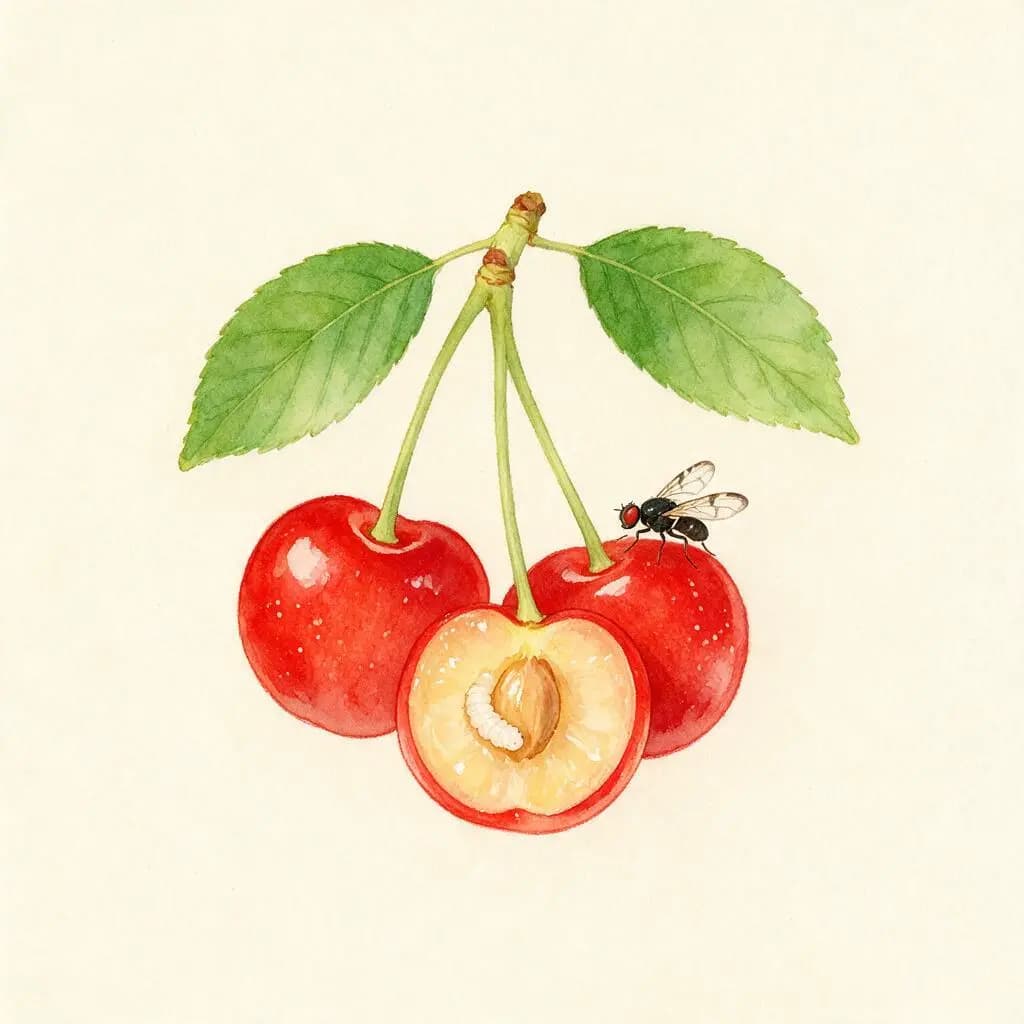
Cherry fruit fly
Also known as: cherry fruit fly, European cherry fruit fly, cherry maggot, Rhagoletis cerasi
A small fly with banded wings whose larvae develop inside the cherry. It is responsible for the little white maggot you find when you bite into the fruit. The first step is to hang yellow traps before the fruit starts to colour and gather up fallen fruit.

How to recognise it at every stage
Shares your gardenIt likes your cherries.
Life cycle: A single generation a year: the fly emerges as the cherries start to colour, the larva lives in the fruit for a few weeks and the pupa spends almost a year buried under the tree.
Tap a stage to see it full size. The photos are AI reference images checked against real photographs; stages without a reliable photo are shown as text only.
Life-stage calendar
| Jan | Feb | Mar | Apr | May | Jun | Jul | Aug | Sep | Oct | Nov | Dec | |
|---|---|---|---|---|---|---|---|---|---|---|---|---|
| Egg (sting) | ||||||||||||
| Larva | ||||||||||||
| Pupa | ||||||||||||
| Fly |
Approximate months for mainland Spain; in cold areas they start later and in warm areas they last longer. Garden creatures this month
No reliable photo yet
1Keep an eye on itEgg (sting)
· 0.7 mmNot visible: a tiny dot on the cherry skin.
- Where to find it
- Under the skin of cherries turning from green to yellow.
- When: May–Jul
- What to do
- Hang yellow traps when the cherries start to colour.
- 2Protect your plants
Larva
· 4-6 mmA small white legless maggot next to the stone; the cherry softens and sinks on one side.
- Where to find it
- Inside the cherry.
- When: May–Jul
- What to do
- Harvest all the cherries (late ones too) and pick up the fallen fruit.
- Often confused with
- Spotted-wing drosophila (D. suzukii). Smaller, more numerous larvae in soft fruit; the adult is a small brown red-eyed fly.
- 3Keep an eye on it
Pupa
· 4 mmA small yellow-brown barrel.
- Where to find it
- In the top centimetres of soil under the cherry tree, until the following spring.
- When: all year
- What to do
- Mesh or fabric on the ground under the tree in May stops the flies emerging.
- 4Protect your plants
Fly
· 4-5 mmA shiny black fly with a yellow shield and clear wings crossed by four dark bands.
- Where to find it
- On cherry leaves and fruit.
- When: May–Jul
- What to do
- Yellow traps and mesh over small trees during ripening.
Often confused with
- Spotted-wing drosophila (D. suzukii). Smaller, more numerous larvae in soft fruit; the adult is a small brown red-eyed fly.
How to recognise it (symptoms)
- A softened, slightly dark area next to the stalk
- A white larva 4-5 mm long inside the fruit when you split it
- Cherries that drop early or soften near the stalk
Crops affected


What favours it
- Warm springs, which bring the adults out earlier
- Late varieties, which are more exposed to the fly's flight period
Prevention
- Choose early varieties, which escape the main flight period
- Gather fallen cherries and put them in the rubbish bin so that the larva cannot complete its cycle
- Turn the soil or cover it under the tree to make it harder for the flies to emerge
Organic treatment
Always start here: these remedies are kind to the garden, the soil and pollinators.
- First: hang yellow sticky traps in the canopy before the fruit starts to colour (one or several per tree depending on its size) and check the catches every week
- Spinosad bait, accepted in organic farming, only as a registered product and following the label
- On small trees, fine mesh covering the whole tree stops the flies laying their eggs
Don't confuse it with…
With Drosophila suzukii (spotted wing drosophila), which also attacks cherries and thin-skinned fruit (raspberry, blackberry, fig). In that case there are usually several small larvae per fruit, whereas with cherry fruit fly there is just one.
In-depth guide — cherry fruit fly
Rhagoletis cerasi lays its eggs in the cherry when it starts to change colour. If traps are not put up in time, you find the larva when you bite into the fruit.
Timing
Put up yellow sticky traps before the fruit starts to colour and check the catches every week.
- Harvest susceptible varieties early.
- Do not leave overripe cherries on the tree.
Hygiene
Fruit that falls to the ground keeps the cycle going into the following year.
- Gather fallen cherries and put them in the rubbish bin.
- On small trees, fine mesh is an option where practical.
Use plant protection products responsibly, even organic ones. Always read and follow the label, the doses and the harvest interval, and never treat plants in flower or while bees are flying, in order to protect pollinators. If in doubt, put prevention and organic methods first.

In the plant catalogue you'll see what to plant, how and when: a well-tended plant resists pests much better.