
Home growing · Medicinal
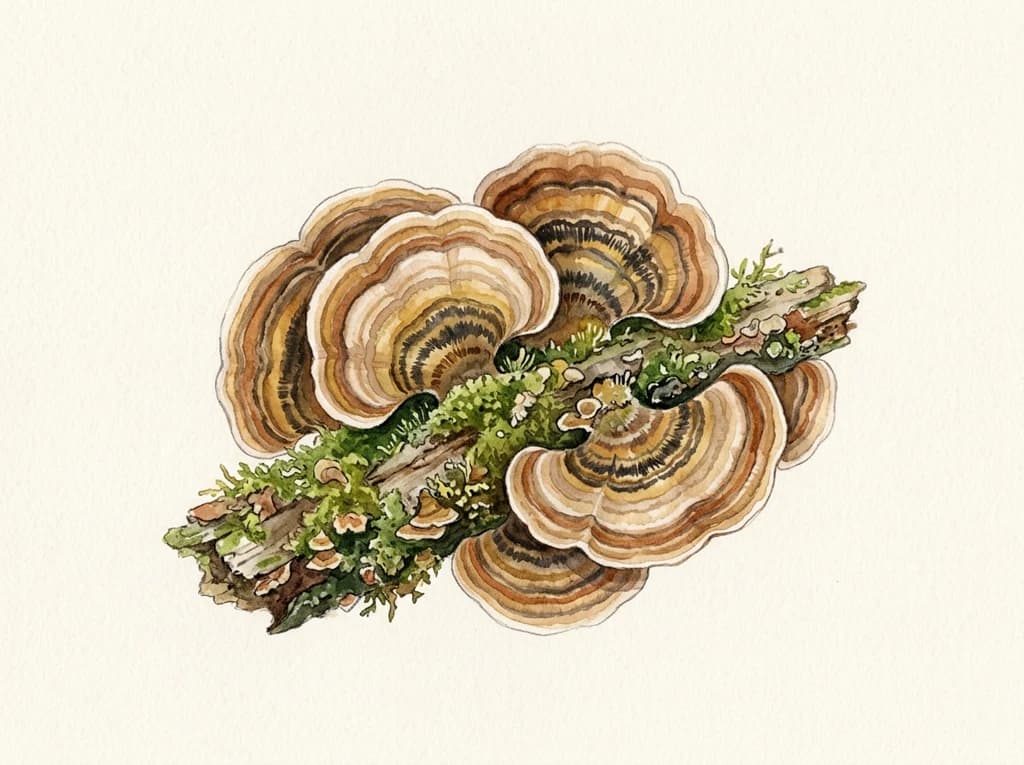
Turkey tail
Trametes versicolor
Also called: yun zhi, many-zoned polypore
Very easy to find in the woods (it grows on fallen beech, oak and chestnut logs) with a striped fan shape. Its woody texture prevents eating it, but it is one of the most studied medicinal mushrooms: PSK is used in Japan as a complementary treatment in oncology and PSP is being studied in China. Always under medical supervision.
Growing step by step
Suitable substrates
Materials needed
- Freshly cut hardwood logs
- Plugs inoculated with Trametes
- A shaded outdoor area
Steps
- 1Drill the log every 15 cm and hammer in the plugs with mycelium.
- 2Seal the holes with melted wax.
- 3Place the log in a damp, shaded area. It can take a year or more to fruit.
- 4Harvest young specimens, still flexible.
Tips that work
- In the woods it colonises fallen logs on its own. If you gather it wild, have it identified by an expert: it has look-alikes among other wood fungi.
Common mistakes
- Confusing it with Stereum (similar in appearance but without medicinal interest): underneath, Trametes has tiny visible pores and Stereum has a smooth underside.
In the kitchen
Not edible because of its texture. Bitter as an infusion.
Quick ideas
- Decoction: simmer a few grams of dried mushroom in a litre of water for one or two hours; the exact amount should be given to you by a professional.
- Alcohol extract (tincture), better bought from a reliable manufacturer.
How to keep it
- Dried it lasts a long time in a dark, closed jar.
Properties
- A source of PSK (Krestin) and PSP, polysaccharides with clinical studies as a complementary treatment in oncology; it does not replace medical treatment.
Precautions
- Consult your doctor if you are on immunosuppressive or cancer treatment, and do not self-medicate with it.
How to get its mycelium

Which methods work
- Tissue clone Works
From a specimen that you bought or grew, not from the forest.
- Spore print Possible
Works, with variability.
- Cardboard and stems Does not work
Not suitable.
- Plugs in logs Works
Works well on hardwood logs.
- Ideal substrate
- Hardwood logs (oak, beech, birch) or sawdust.
- Incubation
- 22-26 °C, in the dark.
- Fruiting
- 18-25 °C, light and humidity.
- Timings
- Dish 14-21 days · grain 21-28 days · log 6-12 months · block 6-8 weeks.
- Difficulty
- Advanced because of its slowness; the fungus itself is very hardy.
It is tough and leathery and is not eaten as a mushroom: it is used as an infusion. Grow it only if you know how to identify it.
At which stage to take mycelium to multiply it
- A young, fresh mushroom (to clone it)Ideal momentStage: Fruiting
When: At fruiting, with a mushroom from the flush you have just harvested: firm, healthy, with the cap closed or barely open and before it drops spores. Choose the best of the harvest: the clone comes out identical to it.
How: Tissue cloning: break the mushroom open, cut a small piece from the inside (not from the surface) with a knife cleaned with alcohol and place it on an agar plate or on clean cardboard. When the plate is colonised, you have a mother culture.
- A mature mushroom that is already dropping sporesPossibleStage: Fruiting
When: With the cap already open: it is no use for cloning, but it is for taking spores (each spore is a new genetic combination, less predictable than a clone).
How: Spore print: rest the cap on clean paper or glass for a few hours, covered, and keep the print. It is germinated later on agar; it is slower and less reliable than cloning.
- A plate 100% colonisedIdeal momentStage: Mycelium colonising
When: When the mycelium has covered the whole plate, is white and clean and there are no patches of other colours. Do not wait for weeks: it ages and dries out.
How: Cut pieces from the growing edge (the youngest) with a flamed tool and move them to jars of sterilised grain or to another plate. Keep a sealed mother plate in the fridge.
Agar plate (mother culture)Colonisation (mycelium)Spawn (colonised grain)
- Grain 100% colonised (spawn)Ideal momentStage: Mycelium colonising
When: When all the grains are covered in mycelium and come loose when you shake the jar. It is the moment to seed the substrate or to spread it into more jars.
How: Mix the grain with the pasteurised or sterilised substrate (around 10% of the wet weight) or tip part of it into new jars of sterilised grain. Do not chain many generations.
Spawn (colonised grain)Mushroom substratePasteurisationInoculation
- Substrate just 100% colonisedPossibleStage: Mycelium colonising
When: Only with very vigorous species (oyster) and right when colonisation ends, before the shock and the primordia. More risk of contamination than with grain.
How: Break off a handful of colonised substrate and mix it with new, pasteurised and drained substrate (between 10 and 20% colonised). Close it and leave it to incubate.
- Colonised plugs or logsPossibleStage: Mycelium colonising
When: Wooden plugs 100% colonised (white right to the tip). A log that is already fruiting is not a good source.
How: Sow the plugs in new, freshly cut hardwood logs: drill, insert the plugs and seal with wax.
- With primordia or during the shockBetter notStage: Primordia (tiny pins)
When: The mycelium is devoting its energy to forming mushrooms: it is a poor source, weaker and with more risk of carrying contamination.
How: Let it fruit and take the mycelium from a young mushroom (clone) or, earlier, from the plate or the grain.
- Between flushes or with exhausted substrateBetter notStage: Rest between flushes
When: After several flushes the mycelium is tired and the substrate full of competitors. Nor with half-colonised material, with coloured patches or a sour smell.
How: Finish the cycle, compost the spent substrate and start again from a clean mother culture.
Step-by-step instructions for each method, with diagrams and safety warnings: guide to getting and multiplying mycelium. Only grow species that you have identified with certainty and do not pick from the wild to clone.

More mushrooms to discover
Explore the full catalogue with button mushrooms, gourmet (chanterelle, porcini), medicinal (reishi, turkey tail) and ones you can grow from your kitchen.
See all the mushrooms