
Wild edible · Gourmet
Saffron milk cap
Lactarius deliciosus y especies afines
Also called: red pine mushroom, orange milk cap
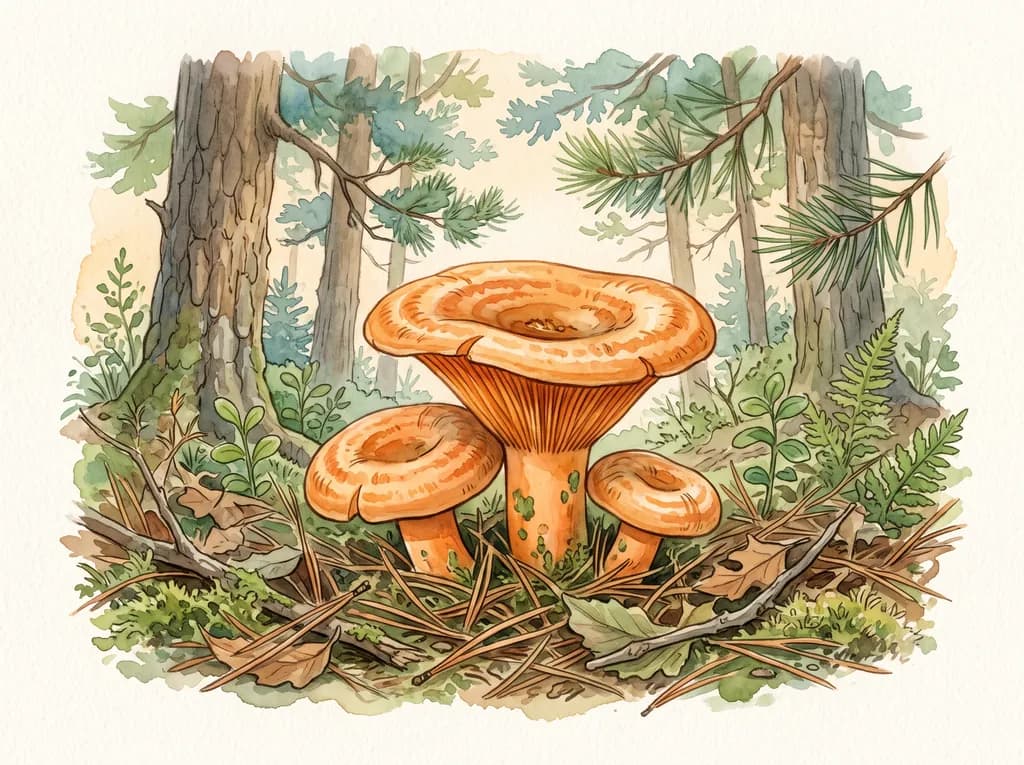
One of the most sought-after mushrooms in Spain. It grows in pine woods in autumn, after the rains, attached to the roots of pines, so it cannot be grown on a substrate. The cap is orange, with darker zones in rings, slightly sunken in the centre and with the edge rolled in when young. When cut or when the gills are broken it gives off an orange milky juice, and over time it stains green. The stem is short, hollow and often has small pits. There are several similar edible species; other milk caps, with white juice, are not. Always have an expert confirm it.
Responsible foraging
Materials
- Wicker basket (never plastic bags) and a small knife with a brush
- Field guide and, better still, an experienced mycologist
- Permit or information on the foraging rules where you live (in many places there is a limit on quantity)
Where and how to look for it
- 1It comes up in autumn, after the rains, in pine woods with acid soil and some moss or pine litter.
- 2Cut it with a knife at ground level, without pulling out the mycelium, and clean off the soil and needles on the spot.
- 3Cut one open to see the juice: it should be orange (or wine red in the bloody milk cap) and not white or watery. Place them gills up in the basket.
Do not confuse it with
Lactarius torminosus (toxic; white juice, pinkish cap with a woolly fringe at the edge), Lactarius chrysorrheus (white juice that turns yellow; hot) and other milk caps with white juice. Lactarius sanguifluus and Lactarius vinosus, with wine-red or reddish juice, are also edible and highly prized. The useful rule is orange or red juice, never white, but no single feature is enough. Never eat a mushroom unless an expert has identified it.
In the kitchen
Meaty, with a woodland flavour and a slightly bitter note. Its texture stands up well to the griddle.
Quick ideas
- Griddled or grilled with oil, garlic and parsley, well cooked on both sides.
- In stews with meat or potatoes, in rice or in scrambled eggs.
- Baked with oil and salt, gills up.
How to keep it
- Fresh it does not keep well: use it within a day or two, in the fridge and unwashed until you are going to use it.
- Freeze it already cooked (sautéed or griddled); raw it spoils when thawed. Drying it is not recommended because it loses its aroma and turns bitter.
- In oil or pickle only with a reliable preserving recipe: without the right acidity and sterilisation there is a risk of botulism.
Precautions
- Always eat it well cooked. Old specimens or ones with grubs can cause digestive upsets.
- Do not try to grow it: there is no saffron milk cap mycelium that works at home. Be wary of “saffron milk cap kits”.
- Do not eat any wild mushroom unless a mycologist or a mycological society has identified it.
How to get its mycelium
This is a mycorrhizal mushroom: it lives attached to the roots of a tree and cannot be grown from mycelium in a jar, a bag or a log. Saffron milk caps are not grown from mycelium at home. Do not buy “saffron milk cap mycelium” or “saffron milk cap kits”: they do not work.
- Companion tree
- Pine (maritime pine, stone pine or Scots pine, depending on the milk cap species).
- Timescale
- From 2 to 4 years at best, with no guarantee that it will fruit.
What you do in practice
- There are pine plants mycorrhized with saffron milk cap in specialised nurseries, and it is among the mycorrhizal mushrooms with the most reliable results in plantations. Buy only with a guarantee of mycorrhization.
- Plant in loose, acid, well-drained ground, without fertilising or liming, and without digging the soil around it.
- If you want to encourage it, protect the pine wood where it already lives: do not compact the soil or remove the leaf litter or the moss.
Step-by-step instructions for each method, with diagrams and safety warnings: guide to getting and multiplying mycelium. Only grow species that you have identified with certainty and do not pick from the wild to clone.

More mushrooms to discover
Explore the full catalogue with button mushrooms, gourmet (chanterelle, porcini), medicinal (reishi, turkey tail) and ones you can grow from your kitchen.
See all the mushrooms