
Home growing · Medicinal
Reishi
Ganoderma lucidum
Also called: ling zhi, mushroom of immortality, mannentake
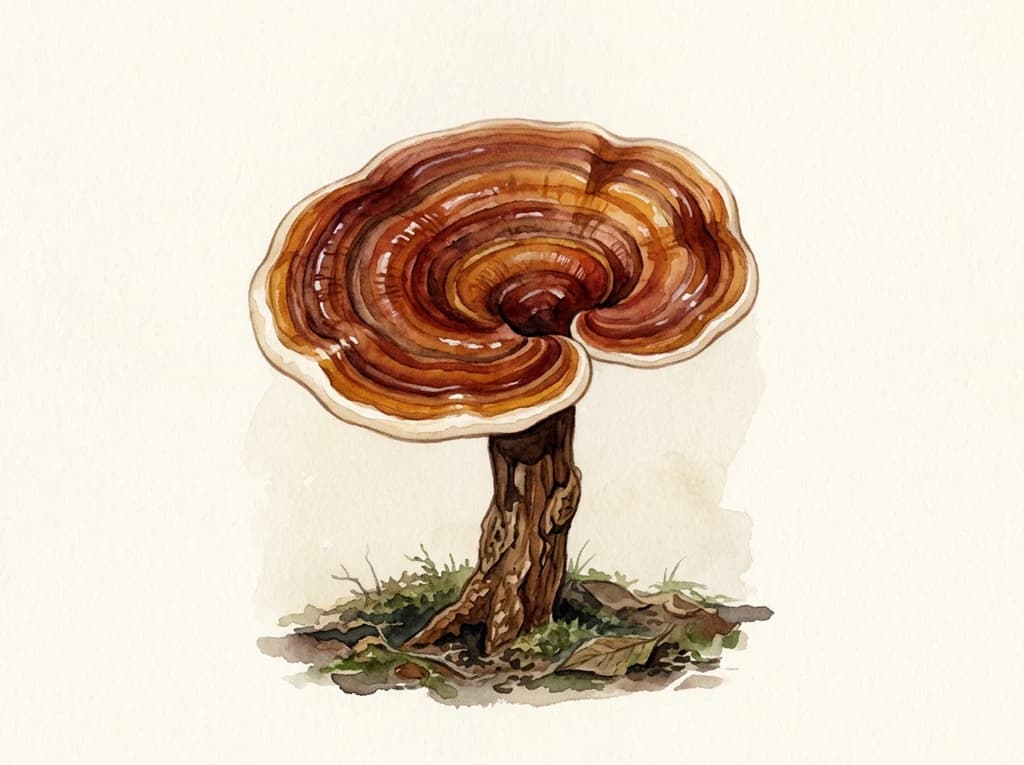
A glossy red-brown lacquered cap, woody texture (it is not eaten as is). It has been used for centuries in traditional Chinese and Japanese medicine. It is prepared as a long decoction (several hours) or as an alcohol extract.
Growing step by step
Suitable substrates
Materials needed
- Block of oak/poplar sawdust inoculated with reishi
- A warm (22–28 °C), very humid environment
- Soft indirect light
Steps
- 1Wait until the block is completely colonised (about 4–6 weeks).
- 2Make a small cut in the bag and wait for reddish “horns” to come out.
- 3Let it grow for a few months until it takes the shape of a lacquered kidney.
- 4Harvest when the white edge has fully taken on the reddish colour.
Tips that work
- With little light it grows as an elongated horn (equally valid, but less showy).
- Dried, it can be ground to a powder for infusions.
Common mistakes
- Late harvest: it hardens even more and fills with brown spores that dirty everything; pick it when the edge is already reddish.
In the kitchen
Intensely bitter. It is not cooked: it is prepared as a decoction.
Quick ideas
- Cut into thin slices and simmer in water for a couple of hours or more.
- As a powder: a small amount dissolved in coffee or an infusion, following the dose indicated by a professional or the manufacturer.
How to keep it
- Dried it lasts a long time in a dark, closed jar.
- Powder or alcohol extract (tincture).
Properties
- Traditional use in Asia as a tonic; sometimes called an “adaptogen” in the popular sense, not as an approved drug.
- It contains triterpenes and beta-glucans studied in the laboratory; it does not replace any medical treatment.
Precautions
- It may interact with anticoagulants and immunosuppressants. Consult your doctor if you take medication, are pregnant or breastfeeding, or have liver problems: isolated cases of liver damage have been reported with reishi preparations.
How to get its mycelium

Which methods work
- Tissue clone Works
More reliable than a spore print; it grows slowly.
- Spore print Possible
Very productive in spores, but beware of allergy: they release a lot of brown dust.
- Cardboard and stems Does not work
Not suitable.
- Plugs in logs Possible
Works on oak or beech, though it takes a while to colonise.
- Ideal substrate
- Hardwood sawdust supplemented with bran, or oak or chestnut logs.
- Incubation
- 24-28 °C, in the dark.
- Fruiting
- 21-28 °C, humidity 85-95%, little ventilation to lengthen the "antlers", and light.
- Timings
- Dish 14-28 days · grain 21-28 days · block 4-8 weeks · primordia 2-4 weeks more · harvest after 3-4 months.
- Difficulty
- Advanced: slow, needs warmth and sporulates heavily.
It is more medicinal than culinary: it is taken as an infusion or extract, never as a fresh mushroom. Harvest before it releases its spore dust.
At which stage to take mycelium to multiply it
- A young, fresh mushroom (to clone it)Ideal momentStage: Fruiting
When: At fruiting, with a mushroom from the flush you have just harvested: firm, healthy, with the cap closed or barely open and before it drops spores. Choose the best of the harvest: the clone comes out identical to it.
How: Tissue cloning: break the mushroom open, cut a small piece from the inside (not from the surface) with a knife cleaned with alcohol and place it on an agar plate or on clean cardboard. When the plate is colonised, you have a mother culture.
- A mature mushroom that is already dropping sporesPossibleStage: Fruiting
When: With the cap already open: it is no use for cloning, but it is for taking spores (each spore is a new genetic combination, less predictable than a clone).
How: Spore print: rest the cap on clean paper or glass for a few hours, covered, and keep the print. It is germinated later on agar; it is slower and less reliable than cloning.
- A plate 100% colonisedIdeal momentStage: Mycelium colonising
When: When the mycelium has covered the whole plate, is white and clean and there are no patches of other colours. Do not wait for weeks: it ages and dries out.
How: Cut pieces from the growing edge (the youngest) with a flamed tool and move them to jars of sterilised grain or to another plate. Keep a sealed mother plate in the fridge.
Agar plate (mother culture)Colonisation (mycelium)Spawn (colonised grain)
- Grain 100% colonised (spawn)Ideal momentStage: Mycelium colonising
When: When all the grains are covered in mycelium and come loose when you shake the jar. It is the moment to seed the substrate or to spread it into more jars.
How: Mix the grain with the pasteurised or sterilised substrate (around 10% of the wet weight) or tip part of it into new jars of sterilised grain. Do not chain many generations.
Spawn (colonised grain)Mushroom substratePasteurisationInoculation
- Substrate just 100% colonisedPossibleStage: Mycelium colonising
When: Only with very vigorous species (oyster) and right when colonisation ends, before the shock and the primordia. More risk of contamination than with grain.
How: Break off a handful of colonised substrate and mix it with new, pasteurised and drained substrate (between 10 and 20% colonised). Close it and leave it to incubate.
- Colonised plugs or logsPossibleStage: Mycelium colonising
When: Wooden plugs 100% colonised (white right to the tip). A log that is already fruiting is not a good source.
How: Sow the plugs in new, freshly cut hardwood logs: drill, insert the plugs and seal with wax.
- With primordia or during the shockBetter notStage: Primordia (tiny pins)
When: The mycelium is devoting its energy to forming mushrooms: it is a poor source, weaker and with more risk of carrying contamination.
How: Let it fruit and take the mycelium from a young mushroom (clone) or, earlier, from the plate or the grain.
- Between flushes or with exhausted substrateBetter notStage: Rest between flushes
When: After several flushes the mycelium is tired and the substrate full of competitors. Nor with half-colonised material, with coloured patches or a sour smell.
How: Finish the cycle, compost the spent substrate and start again from a clean mother culture.
Step-by-step instructions for each method, with diagrams and safety warnings: guide to getting and multiplying mycelium. Only grow species that you have identified with certainty and do not pick from the wild to clone.

More mushrooms to discover
Explore the full catalogue with button mushrooms, gourmet (chanterelle, porcini), medicinal (reishi, turkey tail) and ones you can grow from your kitchen.
See all the mushrooms