
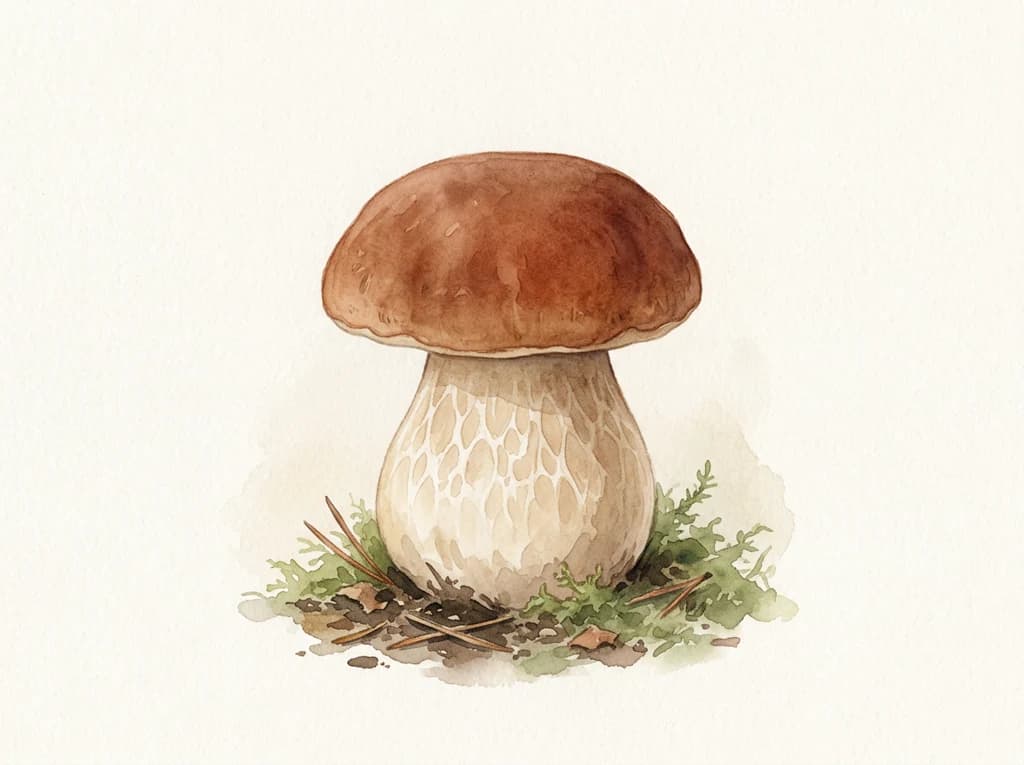
Wild edible · Gourmet
Porcini (Boletus edulis)
Boletus edulis
Also called: penny bun, cep, king bolete
One of the most sought-after mushrooms in the world for its flavour and texture. It lives in symbiosis with the roots of particular trees, so it cannot be grown on a substrate block at home. Attempts with mycorrhised trees have not given reliable results.
Responsible foraging
Materials
- Wicker basket (lets the mushrooms breathe; never use plastic bags)
- Small mushroom-picker’s knife with a brush
- Field guide and, better still, the company of an experienced mycologist
Where and how to look for it
- 1It usually appears after the rains of late summer and autumn in pine woods, chestnut groves, beech woods and oak woods.
- 2It is looked for in areas with leaf litter and partial shade.
- 3Cut it with a knife close to the ground, being careful not to pull out the mycelium, and clean the stem on the spot.
Do not confuse it with
Rubroboletus satanas (toxic; reddish pores, turns blue when cut), Caloboletus radicans (bitter) and Tylopilus felleus (bitter). Other look-alikes are possible, and the features change with the age of the specimen. If in doubt, throw it away and consult a mycologist.
In the kitchen
Intense, creamy, pure umami.
Quick ideas
- Thick slices griddled with oil and flaky salt.
- Risotto with dried and rehydrated porcini.
- Cream soup with leek and potato.
How to keep it
- Dried: it is the best way to keep its flavour.
- In oil only with a reliable preserving recipe: without the right acidity and sterilisation there is a risk of botulism.
Precautions
- Do not eat it unless a mycologist has confirmed the species. If in any doubt, throw it away.
- Old specimens, with soft tubes that are olive green or brown, or with grubs, can cause digestive upsets: pick only young, firm specimens, and always cook them.
How to get its mycelium

This is a mycorrhizal mushroom: it lives attached to the roots of a tree and cannot be grown from mycelium in a jar, a bag or a log. Porcini are not grown from mycelium at home. Do not buy "porcini mycelium" or "porcini kits": it is a promise with no basis.
- Companion tree
- Pine, chestnut, beech or oak, depending on the porcini species.
- Timescale
- Several years (3 to 10 or more) and no guarantee that it will fruit.
What you do in practice
- Buy mycorrhized plants from a specialist nursery that certifies the mycorrhization (with the percentage of mycorrhized roots), and plant them in ground suited to the tree and the fungus.
- Boletus edulis has been mycorrhized experimentally in nursery plants, but there is no reliable commercial cultivation: do not expect harvests as with truffles.
- Respect the soil: do not fertilise or add lime, do not dig or till, protect the soil from compaction and keep the tree healthy.
Step-by-step instructions for each method, with diagrams and safety warnings: guide to getting and multiplying mycelium. Only grow species that you have identified with certainty and do not pick from the wild to clone.

More mushrooms to discover
Explore the full catalogue with button mushrooms, gourmet (chanterelle, porcini), medicinal (reishi, turkey tail) and ones you can grow from your kitchen.
See all the mushrooms