
Wild edible · Gourmet
Parasol mushroom
Macrolepiota procera
Also called: parasol
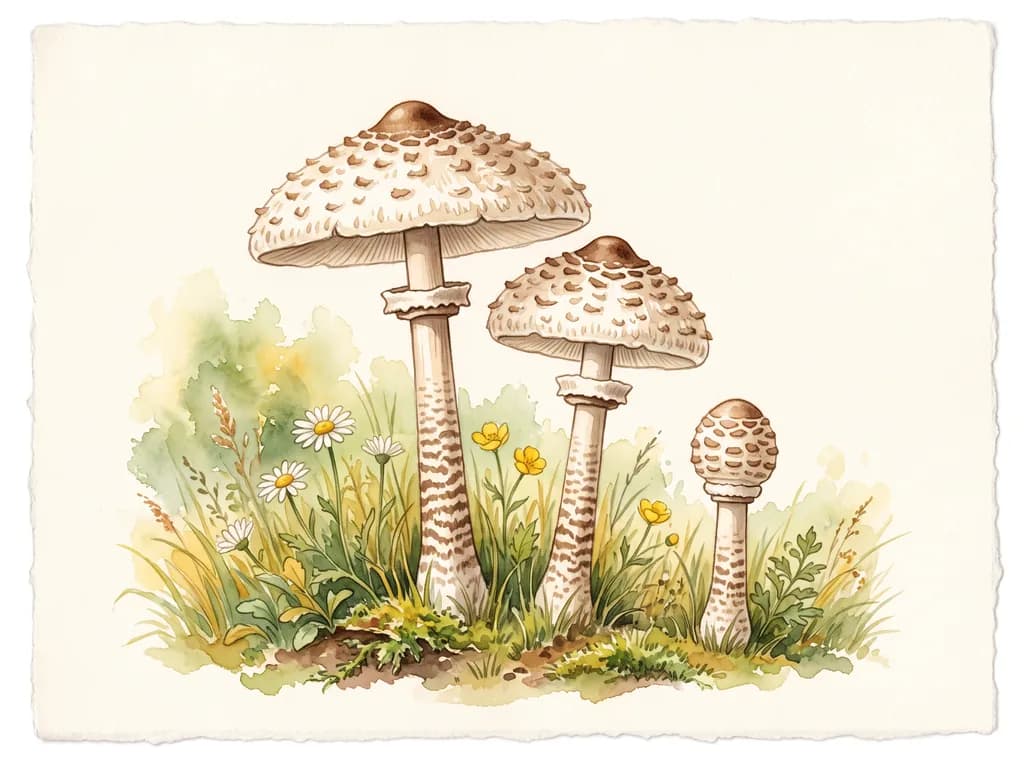
One of the most striking mushrooms: the cap, 10 to 30 cm, is cream-coloured with brown scales and a dark bump in the centre; the stem, slender and very long, has a snakeskin pattern and a double ring that slides up and down. The base of the stem is somewhat swollen but has no volva, and the gills are white and do not touch the stem. It grows in clearings, pastures and woodland edges, from summer to autumn. When young it is shaped like a drumstick. It is not grown at home with reliable results.
Responsible foraging
Materials
- Wicker basket (never plastic bags) and a knife
- Field guide and, better still, an experienced mycologist
- Permit or information on the foraging rules where you live
Where and how to look for it
- 1It is looked for from late summer to autumn, after the rains, in woodland clearings, meadows and the edges of tracks.
- 2Pick only big, open specimens (cap wider than about 12-15 cm) and take them whole to see the base of the stem and the ring.
- 3At home, remove the stem, which is tough and fibrous and is not eaten, and use only the cap.
Do not confuse it with
With Chlorophyllum molybdites (toxic) and Chlorophyllum rhacodes (can disagree with you), and with small lepiotas, some of them deadly, such as Lepiota brunneoincarnata, which are mistaken for young or small parasols. A genuine parasol is big, with a snakeskin-patterned stem and a sliding ring, but no single feature is enough. Never eat a mushroom unless an expert has identified it.
In the kitchen
Mild, nutty and mushroomy. The cap has a light, spongy texture.
Quick ideas
- The whole cap, breaded or battered and fried like a cutlet, is the classic recipe.
- Griddled with oil, garlic and salt, or sliced and sautéed for scrambled eggs and omelettes.
- Always well cooked (raw it upsets many people); throw away the stem.
How to keep it
- Fresh it does not last: use it within a day or two, in the fridge and in a paper bag.
- Freeze it already cooked; raw it spoils when thawed.
- Caps cut in thin slices can be dried and kept for months in an airtight jar.
- In vinegar or oil only with a reliable preserving recipe: without the right acidity and sterilisation there is a risk of botulism.
Precautions
- Always eat it well cooked, and only the cap: the stem is fibrous.
- Pick only big, open specimens; small ones are mistaken for deadly lepiotas.
- Some people tolerate parasol badly: the first time, try a small amount.
- Do not eat any wild mushroom unless a mycologist or a mycological society has identified it.
How to get its mycelium
This is a wild mushroom that is not grown from mycelium at home: it needs outdoor conditions that cannot be reproduced in a jar, a bag or a log. The parasol mushroom is not grown from mycelium at home. Beware of “parasol kits”: they are not reliable, and picking without experience mistakes it for toxic species and deadly lepiotas.
- Companion tree
- It needs no tree: it grows in clearings and pastures with organic matter.
- Timescale
- Not applicable.
What you do in practice
- It is not reliably grown at home: there is no parasol mycelium for home use.
- If you want mushrooms at home, use oyster, shiitake or button mushroom kits.
- If you look for it in the countryside, do so with an expert and respect the foraging rules.
Step-by-step instructions for each method, with diagrams and safety warnings: guide to getting and multiplying mycelium. Only grow species that you have identified with certainty and do not pick from the wild to clone.

More mushrooms to discover
Explore the full catalogue with button mushrooms, gourmet (chanterelle, porcini), medicinal (reishi, turkey tail) and ones you can grow from your kitchen.
See all the mushrooms