
Home growing · Medicinal · Gourmet
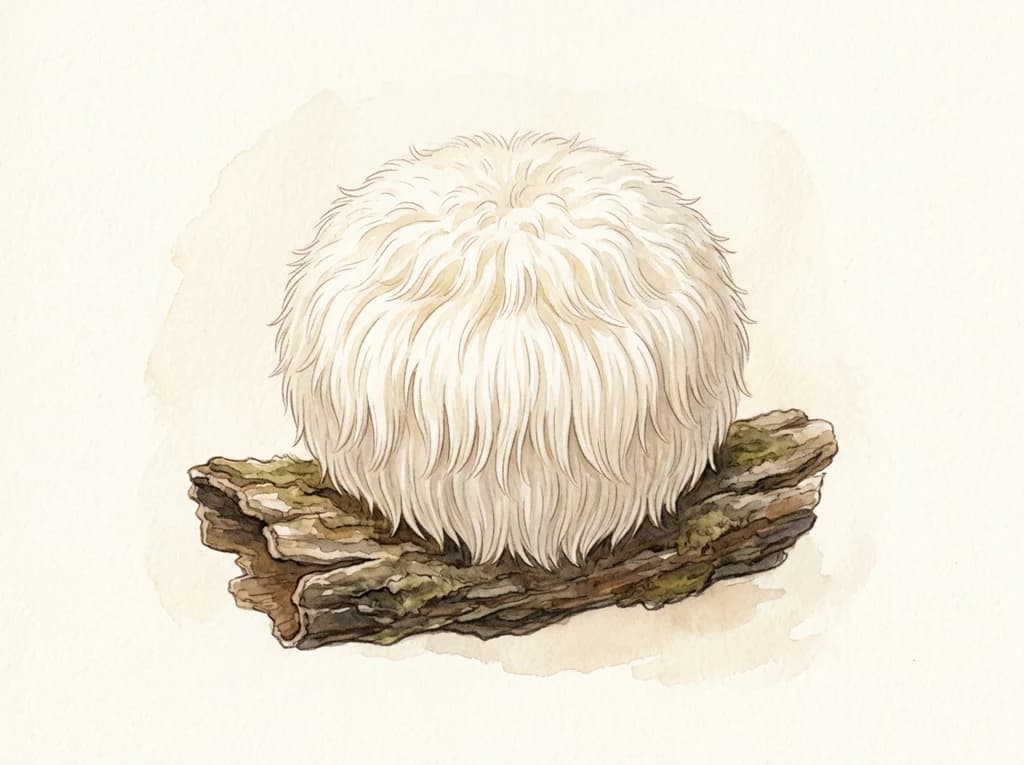
Lion’s mane
Hericium erinaceus
Also called: pom pom mushroom, monkey head, yamabushitake
A spectacular fruiting body: a white ball with long “spines” that recall a mane. Highly prized in cooking. Its compounds (erinacines and hericenones) are being researched; in the laboratory they have stimulated nerve growth factor (NGF); there is no conclusive evidence that they have that effect when eaten.
Growing step by step
Suitable substrates
Materials needed
- Block of inoculated oak sawdust
- An environment with very high humidity (around 90–95%)
- Fresh, gentle air: without ventilation it grows compact and fragile
Steps
- 1Wait until the block is completely colonised (about 4–6 weeks).
- 2Make a single cut in the bag and place it in indirect light.
- 3Spray several times a day. The spines grow until they form a ball of about 10–20 cm.
- 4Harvest before the spines turn yellow or brown, because then they become bitter.
Tips that work
- If the environment is too dry, the spines stay short and the mushroom can dry out.
- It needs good ventilation; without it, it grows compact and fragile.
Common mistakes
- Late harvest: if you let it yellow it loses flavour and texture.
In the kitchen
Delicate, reminiscent of crab, scallop or seafood.
Quick ideas
- Cut into “steaks” and pan-fried in butter: it recalls fish.
- In Asian soups.
- Battered in tempura.
How to keep it
- Dried it keeps its aroma; it rehydrates in hot broth.
Properties
- Traditional use and a subject of research (it is not a medicine).
- Some studies explore compounds related to the nervous system, but it does not replace medical advice.
How to get its mycelium

Which methods work
- Tissue clone Works
Works well with a fresh, young specimen (bought or grown).
- Spore print Possible
It germinates well, though with variability.
- Cardboard and stems Does not work
Not suitable.
- Plugs in logs Possible
Possible on beech or oak, though slower and less reliable than on sawdust.
- Ideal substrate
- Beech or oak sawdust supplemented with wheat bran (80/20) in a block.
- Incubation
- 20-24 °C, in the dark.
- Fruiting
- 16-21 °C, humidity 85-95%, soft light and good ventilation.
- Timings
- Dish 14-21 days · grain 14-21 days · block 3-4 weeks · mushrooms 10-14 days after opening.
- Difficulty
- Medium: sensitive to dryness and poor ventilation.
The wild mushroom is a protected species in several regions: always start from cultivated mycelium, never from the countryside.
At which stage to take mycelium to multiply it
- A young, fresh mushroom (to clone it)Ideal momentStage: Fruiting
When: At fruiting, with a mushroom from the flush you have just harvested: firm, healthy, with the cap closed or barely open and before it drops spores. Choose the best of the harvest: the clone comes out identical to it.
How: Tissue cloning: break the mushroom open, cut a small piece from the inside (not from the surface) with a knife cleaned with alcohol and place it on an agar plate or on clean cardboard. When the plate is colonised, you have a mother culture.
- A mature mushroom that is already dropping sporesPossibleStage: Fruiting
When: With the cap already open: it is no use for cloning, but it is for taking spores (each spore is a new genetic combination, less predictable than a clone).
How: Spore print: rest the cap on clean paper or glass for a few hours, covered, and keep the print. It is germinated later on agar; it is slower and less reliable than cloning.
- A plate 100% colonisedIdeal momentStage: Mycelium colonising
When: When the mycelium has covered the whole plate, is white and clean and there are no patches of other colours. Do not wait for weeks: it ages and dries out.
How: Cut pieces from the growing edge (the youngest) with a flamed tool and move them to jars of sterilised grain or to another plate. Keep a sealed mother plate in the fridge.
Agar plate (mother culture)Colonisation (mycelium)Spawn (colonised grain)
- Grain 100% colonised (spawn)Ideal momentStage: Mycelium colonising
When: When all the grains are covered in mycelium and come loose when you shake the jar. It is the moment to seed the substrate or to spread it into more jars.
How: Mix the grain with the pasteurised or sterilised substrate (around 10% of the wet weight) or tip part of it into new jars of sterilised grain. Do not chain many generations.
Spawn (colonised grain)Mushroom substratePasteurisationInoculation
- Substrate just 100% colonisedPossibleStage: Mycelium colonising
When: Only with very vigorous species (oyster) and right when colonisation ends, before the shock and the primordia. More risk of contamination than with grain.
How: Break off a handful of colonised substrate and mix it with new, pasteurised and drained substrate (between 10 and 20% colonised). Close it and leave it to incubate.
- Colonised plugs or logsPossibleStage: Mycelium colonising
When: Wooden plugs 100% colonised (white right to the tip). A log that is already fruiting is not a good source.
How: Sow the plugs in new, freshly cut hardwood logs: drill, insert the plugs and seal with wax.
- With primordia or during the shockBetter notStage: Primordia (tiny pins)
When: The mycelium is devoting its energy to forming mushrooms: it is a poor source, weaker and with more risk of carrying contamination.
How: Let it fruit and take the mycelium from a young mushroom (clone) or, earlier, from the plate or the grain.
- Between flushes or with exhausted substrateBetter notStage: Rest between flushes
When: After several flushes the mycelium is tired and the substrate full of competitors. Nor with half-colonised material, with coloured patches or a sour smell.
How: Finish the cycle, compost the spent substrate and start again from a clean mother culture.
Step-by-step instructions for each method, with diagrams and safety warnings: guide to getting and multiplying mycelium. Only grow species that you have identified with certainty and do not pick from the wild to clone.

More mushrooms to discover
Explore the full catalogue with button mushrooms, gourmet (chanterelle, porcini), medicinal (reishi, turkey tail) and ones you can grow from your kitchen.
See all the mushrooms