
Wild edible
Field mushroom
Agaricus campestris
Also called: meadow mushroom, pink bottom
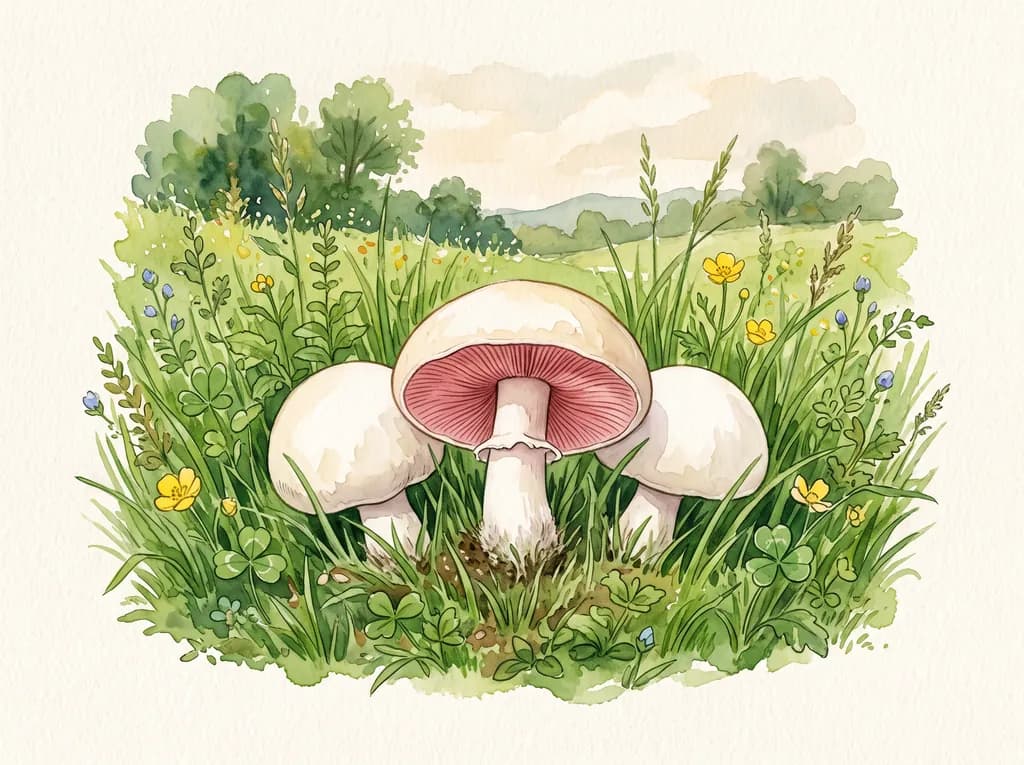
It comes up in meadows and pastures manured by livestock, in autumn and, with rain, also in spring. It has a white or cream cap of 4 to 10 cm, a short white stem with a thin, fragile ring, and flesh that turns slightly pink when cut. The most characteristic feature is the gills: bright pink when young and dark chocolate brown when mature, never white. There is no volva at the base of the stem. Its smell is pleasant, like a mushroom. Even so, there are dangerous look-alikes, some of them deadly: always have an expert confirm it.
Responsible foraging
Materials
- Wicker basket (never plastic bags) and a small knife
- Field guide and, better still, the company of an experienced mycologist
- Permit or information on the foraging rules where you live
Where and how to look for it
- 1It is looked for in meadows, wooded pastures and grazed grassland, in autumn and, after mild rain, in spring. Ask the landowner for permission.
- 2Take the specimen whole, with the base of the stem, so you can see whether there is a volva; clean it on the spot and do not mix it with other mushrooms in the basket.
- 3Before taking it away, check that the gills are not white, that the base of the stem has no volva and that it does not turn yellow or smell of ink or medicine when cut or scratched. If there is any doubt, leave it.
- 4At home, cut one of each group in half and keep another whole to show an expert or a mycological society before cooking it.
Do not confuse it with
With Amanita phalloides, Amanita verna and Amanita virosa (deadly): always white gills, a broad ring and a volva at the base of the stem. With Agaricus xanthodermus (yellow-staining mushroom, toxic): it turns yellow when the base of the stem is cut and smells of ink or phenol. With Entoloma sinuatum (toxic): pink gills, no ring, smell of flour. The safe rule is pink gills that turn dark brown, no volva, no yellowing and a pleasant smell, but no single feature is enough. Never eat a mushroom unless an expert has identified it.
In the kitchen
Aromatic and delicate, stronger than the cultivated button mushroom.
Quick ideas
- Griddled with garlic and parsley, over medium-high heat so it does not release too much water.
- In scrambled eggs or an omelette, sliced and sautéed first.
- In stews, rice dishes and creams; always eat it well cooked.
How to keep it
- Fresh, in the fridge inside a paper bag and no more than 2 or 3 days.
- Freeze it already cooked (sautéed); raw it lets out a lot of water and goes soft.
- Dried it keeps for months in an airtight jar.
- In vinegar or oil only with a reliable preserving recipe: without the right acidity and sterilisation there is a risk of botulism.
Precautions
- The deadly amanitas cause digestive symptoms hours after eating them and may seem to improve while the liver is being damaged. If you have eaten mushrooms and have vomiting or diarrhoea, go to the emergency department (112 in Spain; use your local emergency number elsewhere) with leftovers of the mushroom.
- Do not eat any wild mushroom unless a mycologist or a mycological society has identified it.
- It is not grown from mycelium at home: do not trust “field mushroom kits”.
How to get its mycelium
This is a wild mushroom that is not grown from mycelium at home: it needs outdoor conditions that cannot be reproduced in a jar, a bag or a log. The field mushroom is not grown from mycelium at home. Beware of “field mushroom kits”: they are not reliable, and picking without experience in the countryside can mistake it for deadly amanitas.
- Companion tree
- It needs no tree: it grows in manured meadows and pastures.
- Timescale
- Not applicable.
What you do in practice
- It is not grown at home: cultivation trials are experimental and there is no field mushroom mycelium for amateurs.
- To have button mushrooms at home, use a white or brown button mushroom kit, which is another, already domesticated variety.
- If you look for it in the countryside, do not trample or plough the meadow where it comes up, and check the rules where you live first.
Step-by-step instructions for each method, with diagrams and safety warnings: guide to getting and multiplying mycelium. Only grow species that you have identified with certainty and do not pick from the wild to clone.

More mushrooms to discover
Explore the full catalogue with button mushrooms, gourmet (chanterelle, porcini), medicinal (reishi, turkey tail) and ones you can grow from your kitchen.
See all the mushrooms