
Home growing · Gourmet
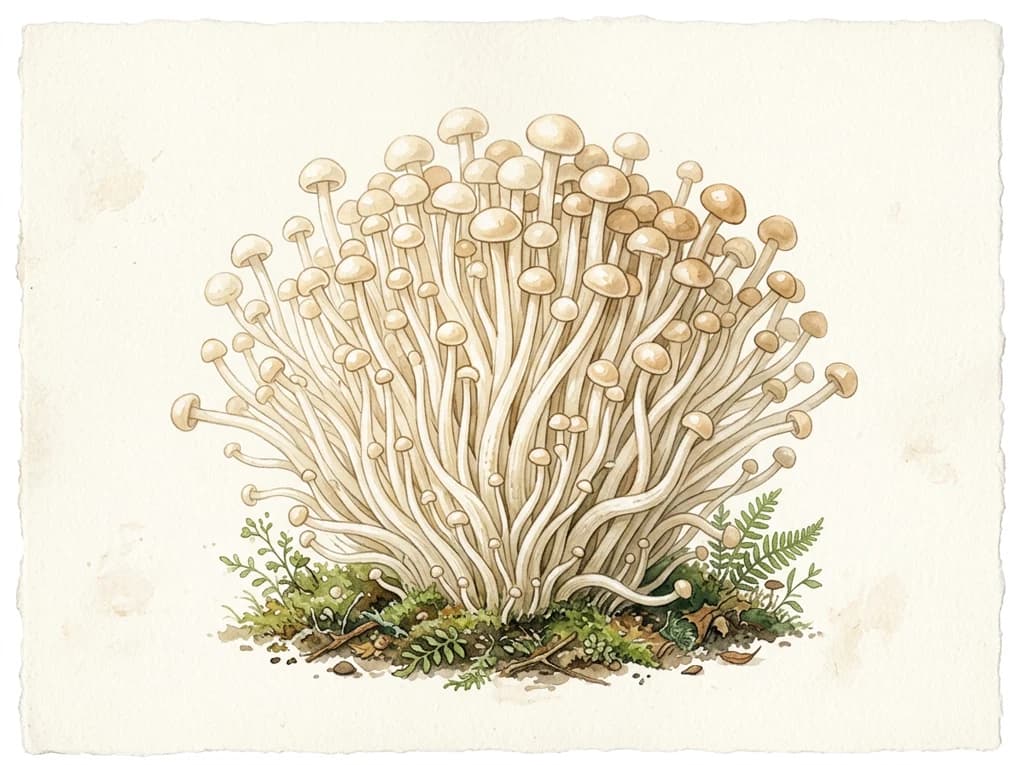
Enoki
Flammulina velutipes
Also called: enokitake, needle mushroom, golden needle, winter mushroom
In the wild it is brown/orange. The white supermarket version is grown in the dark and with raised CO₂, which makes it grow stretched. Always cook it: eating it raw is not recommended, because outbreaks of listeriosis have been linked to commercial enoki.
Growing step by step
Suitable substrates
Materials needed
- Inoculated block (uncommon: it is usually sold in specialist shops)
- Fridge or a very cold area (about 5–12 °C)
- A collar or tall tube around the block so the stems stretch
Steps
- 1Let the block colonise at about 18 °C.
- 2Move it to the cold (about 10 °C) and raise the humidity.
- 3The stem grows very long if there is little light and a lot of CO₂ (little ventilation).
- 4Harvest the whole cluster by cutting it at the base with scissors.
Tips that work
- With light and more ventilation, a bigger cap and a short stem form (more rustic, and also edible).
Common mistakes
- Uneven temperature: abrupt changes between warm and cold weaken the crop and favour moulds.
In the kitchen
Mild, light, slightly fruity.
Quick ideas
- In Asian soups, boiling it in the broth for a few minutes.
- In little parcels wrapped in bacon and pan-fried.
- Sautéed until thoroughly hot and cooked; never raw.
How to keep it
- It lasts only a short time fresh (a few days in the fridge).
- Frozen already cooked, for example inside a soup.
Precautions
- It can be contaminated with Listeria: keep it in the fridge, respect the expiry date and cook it well. Do not eat it raw, and take extra care if you are pregnant, elderly or have a weakened immune system.
How to get its mycelium

Which methods work
- Tissue clone Works
The best method, with a fresh, young specimen.
- Spore print Possible
It germinates, but with variability.
- Cardboard and stems Does not work
Not suitable.
- Plugs in logs Does not work
It is grown on sawdust with bran, not on logs.
- Ideal substrate
- Sawdust supplemented with wheat bran, or with rice bran, in jars or bags.
- Incubation
- 18-22 °C, in the dark.
- Fruiting
- 5-12 °C, humidity 90-95% and a paper "collar" that lengthens the stem.
- Timings
- Dish 10-14 days · grain 14-21 days · block 3-4 weeks · mushrooms 2-3 weeks after opening.
- Difficulty
- Medium: it needs cold.
There is a very similar and deadly wild mushroom (Galerina marginata): grow only from mycelium of a safe origin and never forage for it.
At which stage to take mycelium to multiply it
- A young, fresh mushroom (to clone it)Ideal momentStage: Fruiting
When: At fruiting, with a mushroom from the flush you have just harvested: firm, healthy, with the cap closed or barely open and before it drops spores. Choose the best of the harvest: the clone comes out identical to it.
How: Tissue cloning: break the mushroom open, cut a small piece from the inside (not from the surface) with a knife cleaned with alcohol and place it on an agar plate or on clean cardboard. When the plate is colonised, you have a mother culture.
- A mature mushroom that is already dropping sporesPossibleStage: Fruiting
When: With the cap already open: it is no use for cloning, but it is for taking spores (each spore is a new genetic combination, less predictable than a clone).
How: Spore print: rest the cap on clean paper or glass for a few hours, covered, and keep the print. It is germinated later on agar; it is slower and less reliable than cloning.
- A plate 100% colonisedIdeal momentStage: Mycelium colonising
When: When the mycelium has covered the whole plate, is white and clean and there are no patches of other colours. Do not wait for weeks: it ages and dries out.
How: Cut pieces from the growing edge (the youngest) with a flamed tool and move them to jars of sterilised grain or to another plate. Keep a sealed mother plate in the fridge.
Agar plate (mother culture)Colonisation (mycelium)Spawn (colonised grain)
- Grain 100% colonised (spawn)Ideal momentStage: Mycelium colonising
When: When all the grains are covered in mycelium and come loose when you shake the jar. It is the moment to seed the substrate or to spread it into more jars.
How: Mix the grain with the pasteurised or sterilised substrate (around 10% of the wet weight) or tip part of it into new jars of sterilised grain. Do not chain many generations.
Spawn (colonised grain)Mushroom substratePasteurisationInoculation
- Substrate just 100% colonisedPossibleStage: Mycelium colonising
When: Only with very vigorous species (oyster) and right when colonisation ends, before the shock and the primordia. More risk of contamination than with grain.
How: Break off a handful of colonised substrate and mix it with new, pasteurised and drained substrate (between 10 and 20% colonised). Close it and leave it to incubate.
- With primordia or during the shockBetter notStage: Primordia (tiny pins)
When: The mycelium is devoting its energy to forming mushrooms: it is a poor source, weaker and with more risk of carrying contamination.
How: Let it fruit and take the mycelium from a young mushroom (clone) or, earlier, from the plate or the grain.
- Between flushes or with exhausted substrateBetter notStage: Rest between flushes
When: After several flushes the mycelium is tired and the substrate full of competitors. Nor with half-colonised material, with coloured patches or a sour smell.
How: Finish the cycle, compost the spent substrate and start again from a clean mother culture.
Step-by-step instructions for each method, with diagrams and safety warnings: guide to getting and multiplying mycelium. Only grow species that you have identified with certainty and do not pick from the wild to clone.

More mushrooms to discover
Explore the full catalogue with button mushrooms, gourmet (chanterelle, porcini), medicinal (reishi, turkey tail) and ones you can grow from your kitchen.
See all the mushrooms