
Home growing
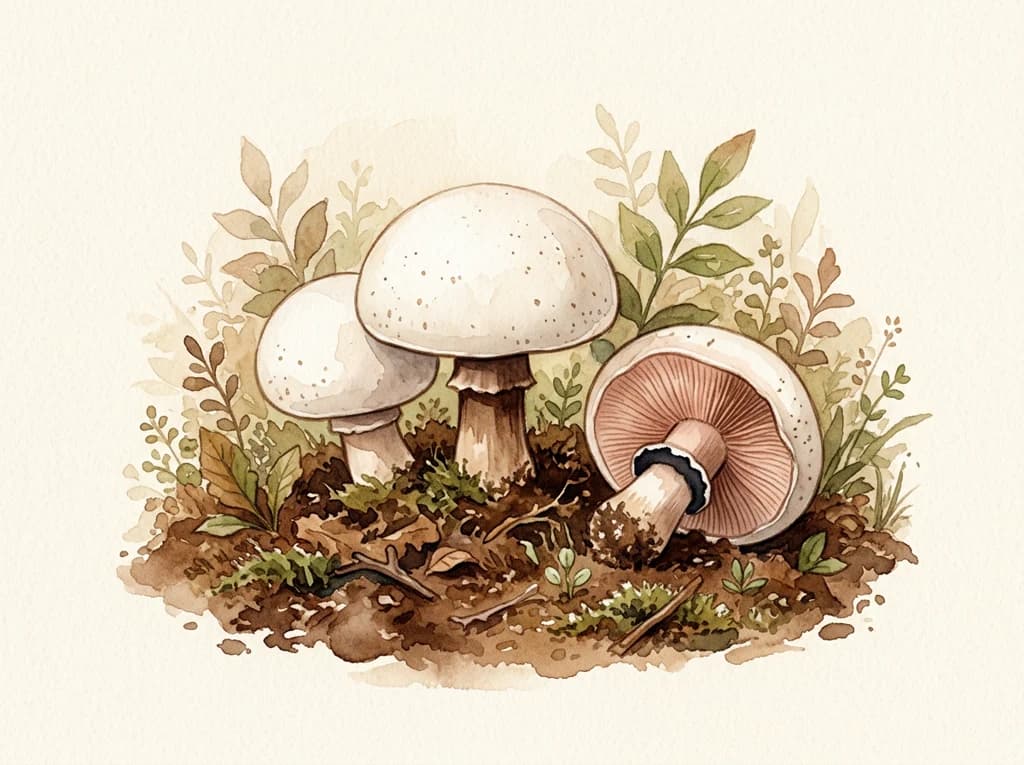
White button mushroom
Agaricus bisporus
Also called: Paris mushroom, cultivated mushroom, portobello (mature brown variety)
The most widely sold cultivated mushroom in the world. A home kit arrives already inoculated and you only have to add the casing layer and water. Its mature brown version is the portobello.
Growing step by step
Suitable substrates
Materials needed
- Commercial kit with substrate already inoculated
- Casing layer (peat + limestone), which usually comes in the kit
- Sprayer
- A dark, cool place (garage, cellar)
Steps
- 1Open the kit and spread the casing layer on top, as thick as the manufacturer says (usually a few centimetres).
- 2Spray without waterlogging for the days the kit indicates (usually a couple of weeks) until the mycelium shows on the surface.
- 3When the “pins” (little white balls) appear, water less so they do not rot.
- 4Pick the mushrooms when the veil under the cap is still closed or has just opened. The kit gives several flushes.
Tips that work
- Harvest by twisting the mushroom with your hand instead of cutting it; that way no stump is left to rot.
- The portobello is the same mushroom in its brown variety, left to mature until the cap opens and the gills darken.
Common mistakes
- Overwatering waterlogs it and sciarid flies appear.
- Temperatures above about 22 °C: many small pins come up and few get to grow.
In the kitchen
Delicate and versatile. The portobello is earthier and tastier.
Quick ideas
- Griddled with garlic and parsley: the dry heat concentrates the flavour and keeps it from going watery.
- Stuffed and baked with ham, cheese or pine nuts.
- Good for a classic cream soup: blend it with softened onion and a little cream or milk.
How to keep it
- Dried it keeps for many months in an airtight jar.
- In vinegar or oil only with a reliable preserving recipe: without the right acidity and sterilisation there is a risk of botulism.
How to get its mycelium

Which methods work
- Tissue clone Works
Take tissue from inside the cap of a young button mushroom with the veil still closed.
- Spore print Possible
Spores of commercial button mushrooms give unpredictable results.
- Cardboard and stems Does not work
It does not colonise cardboard usefully.
- Plugs in logs Does not work
It does not grow on logs: it needs compost.
- Ideal substrate
- Horse compost or fermented pasteurised straw, with a casing layer of peat and limestone.
- Incubation
- 24-26 °C in the mass, in the dark.
- Fruiting
- 14-18 °C after putting on the casing layer, high humidity and plenty of ventilation.
- Timings
- Grain 14-21 days · compost 14-21 days · casing 7-14 days · mushrooms 5-7 days later.
- Difficulty
- Easy with a kit; medium with your own mycelium, because the compost and casing layer need care.
It is safer to buy button mushroom grain spawn and put your effort into the compost and the casing layer.
At which stage to take mycelium to multiply it
- A young, fresh mushroom (to clone it)Ideal momentStage: Fruiting
When: At fruiting, with a mushroom from the flush you have just harvested: firm, healthy, with the cap closed or barely open and before it drops spores. Choose the best of the harvest: the clone comes out identical to it.
How: Tissue cloning: break the mushroom open, cut a small piece from the inside (not from the surface) with a knife cleaned with alcohol and place it on an agar plate or on clean cardboard. When the plate is colonised, you have a mother culture.
- A mature mushroom that is already dropping sporesPossibleStage: Fruiting
When: With the cap already open: it is no use for cloning, but it is for taking spores (each spore is a new genetic combination, less predictable than a clone).
How: Spore print: rest the cap on clean paper or glass for a few hours, covered, and keep the print. It is germinated later on agar; it is slower and less reliable than cloning.
- A plate 100% colonisedIdeal momentStage: Mycelium colonising
When: When the mycelium has covered the whole plate, is white and clean and there are no patches of other colours. Do not wait for weeks: it ages and dries out.
How: Cut pieces from the growing edge (the youngest) with a flamed tool and move them to jars of sterilised grain or to another plate. Keep a sealed mother plate in the fridge.
Agar plate (mother culture)Colonisation (mycelium)Spawn (colonised grain)
- Grain 100% colonised (spawn)Ideal momentStage: Mycelium colonising
When: When all the grains are covered in mycelium and come loose when you shake the jar. It is the moment to seed the substrate or to spread it into more jars.
How: Mix the grain with the pasteurised or sterilised substrate (around 10% of the wet weight) or tip part of it into new jars of sterilised grain. Do not chain many generations.
Spawn (colonised grain)Mushroom substratePasteurisationInoculation
- Substrate just 100% colonisedPossibleStage: Mycelium colonising
When: Only with very vigorous species (oyster) and right when colonisation ends, before the shock and the primordia. More risk of contamination than with grain.
How: Break off a handful of colonised substrate and mix it with new, pasteurised and drained substrate (between 10 and 20% colonised). Close it and leave it to incubate.
- With primordia or during the shockBetter notStage: Primordia (tiny pins)
When: The mycelium is devoting its energy to forming mushrooms: it is a poor source, weaker and with more risk of carrying contamination.
How: Let it fruit and take the mycelium from a young mushroom (clone) or, earlier, from the plate or the grain.
- Between flushes or with exhausted substrateBetter notStage: Rest between flushes
When: After several flushes the mycelium is tired and the substrate full of competitors. Nor with half-colonised material, with coloured patches or a sour smell.
How: Finish the cycle, compost the spent substrate and start again from a clean mother culture.
Step-by-step instructions for each method, with diagrams and safety warnings: guide to getting and multiplying mycelium. Only grow species that you have identified with certainty and do not pick from the wild to clone.

More mushrooms to discover
Explore the full catalogue with button mushrooms, gourmet (chanterelle, porcini), medicinal (reishi, turkey tail) and ones you can grow from your kitchen.
See all the mushrooms