

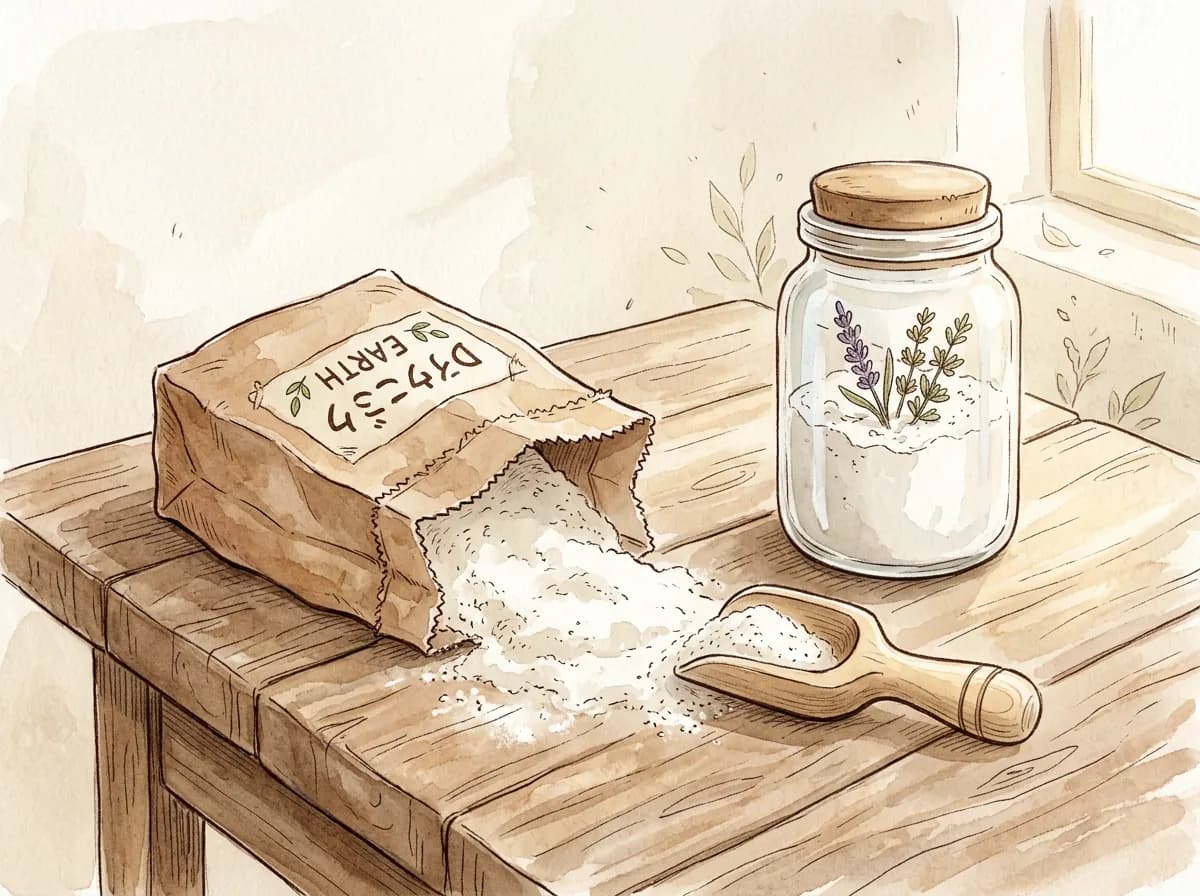
It is the ground-up skeletons of fossilised microscopic algae (diatoms). To the naked eye it looks like white flour; under a microscope it is millions of silica stars with sharp edges.
When an insect or a mite (ant, red mite, beetle…) walks over the powder, its microscopic edges scratch the cuticle. The creature dehydrates and dies within a few hours. It is not a poison: it is physical abrasion.
In the vegetable garden it is dusted, dry, over the soil or on affected plants. Do not apply it to open flowers: it can harm pollinators too. Only buy ‘food grade’; the industrial or swimming-pool kind is no good and is more dangerous to breathe in.
How to use it
- It only works when **dry**: as soon as it rains or gets wet, it loses its effect. Reapply after rain.
- Always buy the **‘food grade’** kind, never the swimming-pool type (calcined, containing crystalline silica, dangerous to breathe in).
- With hens and rabbits: dust the dust-bath area and the cracks in the hen house against red mite, without raising dust while the birds are inside.
- In the vegetable garden: dust around the base of plants attacked by ants and young slugs.
Although it is mineral in origin and of low toxicity, avoid breathing in the cloud of dust when applying it: it irritates the airways. Wear a mask for large applications.