

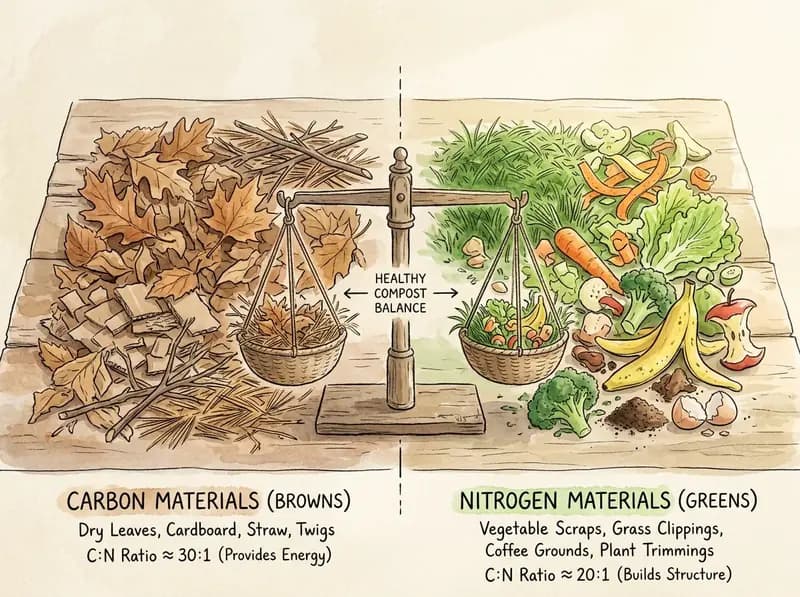
Compost contains two kinds of material: **browns** provide carbon (straw, dry leaves, cardboard, shredded prunings) and **greens** provide nitrogen (kitchen scraps, fresh grass clippings, fresh manure). The ideal proportion between the two is called the C:N ratio.
Compost microorganisms need roughly **30 parts carbon for every 1 part nitrogen** (30:1) to work well. If you overdo the greens the heap slumps, smells bad and turns into a black sludge. If you overdo the browns, it never gets going: it stays dry and cold.
In practice there is no need to get the calculator out: because browns are so rich in carbon, you add **about 2-3 parts brown to 1 part green** by volume. For every layer of green, a layer of brown on top.
How to use it
- If the compost smells of ammonia or rotten eggs: add browns (straw, cardboard, leaves).
- If it does not heat up and is not breaking down: add greens (kitchen scraps, fresh grass clippings).
- In the calculator at `/compost` you can enter what you have and it tells you whether you are short of browns or greens.