
Mineral amendment Liquid Solid
Magnesium sulphate (Epsom salt)
Also called: epsom salt, epsom salts, MgSO4, magnesium sulphate, magnesium sulfate, epsomite, bath salts for plants
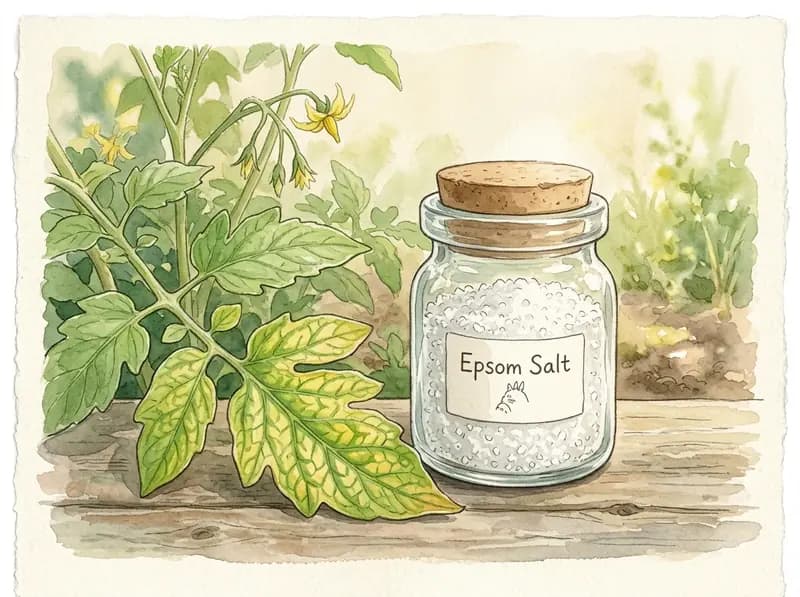
It corrects a magnesium deficiency (older leaves yellowish between green veins). It is not a general fertiliser, but a one-off correction. It is cheap and can be found in garden shops.
N
0 %
Nitrogen
P
0 %
Phosphorus
K
0 %
Potassium
Good-fertiliser rule of thumb. Put organic matter first and use half the dose printed on the label. A garden is spoiled faster by over-feeding than by under-feeding.
What it provides
- Magnesium (Mg)
- Sulphur (S)
When to use it
- Only if you spot a magnesium deficiency: older leaves (the lower ones) yellow between the veins, especially on tomato, potato or rose.
- In sandy or very acid soils, which lose magnesium with watering, or with feeds very rich in potassium, is where the deficiency appears most often.
How to make or apply it
- To spray on the leaves, dissolve 5 g (0.2 oz) per litre of water (a level teaspoon) until no crystals remain.
- For the soil, dissolve it in the irrigation water instead of sprinkling it on dry.
Dose
- On the leaves: 5 g/L, at dawn or dusk, 2-3 times 10-14 days apart.
- To the soil: 10-20 g (0.4–0.7 oz) per m² dissolved in the watering. Maximum 2-3 applications per season.
Good for…
Tomato, potato, rose, citrus with chlorosis.
Precautions
- It is a soluble salt: in excess it makes the soil salty, burns roots and blocks calcium and potassium. Always stick to the dose.
- Do not apply it routinely and without a diagnosis: most soils do not need it. Do not spray in full sun or in hot weather.
Sustainability: Acceptable as a one-off correction; it should not be used as a general fertiliser.
Make your own compost
The best organic fertiliser is made at home from what you would otherwise throw away. Learn to make good compost step by step.