
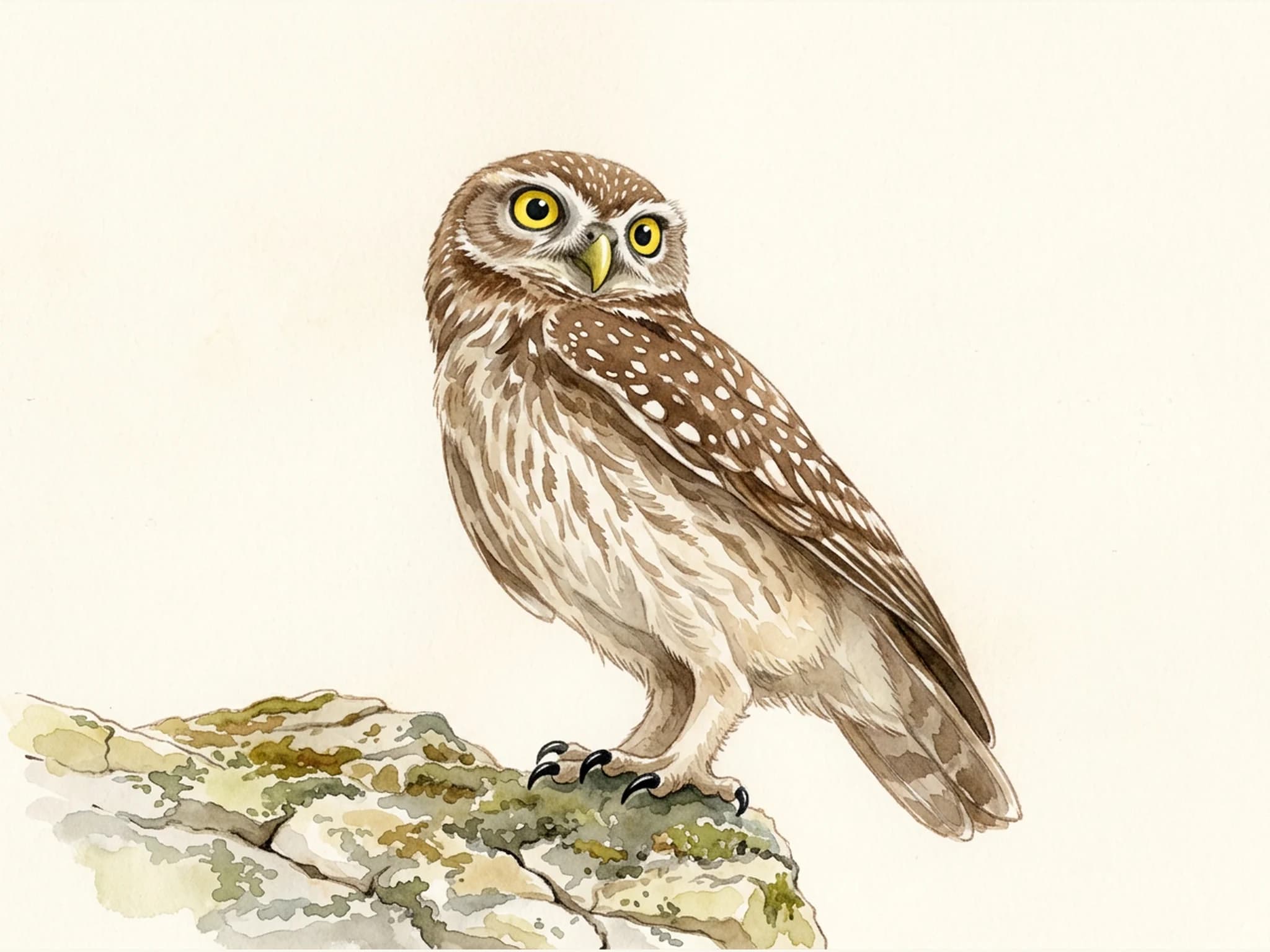
Little owl
Athene noctua
Also called: owl, Athene owl
The little owl that watches over the garden: it eats crickets, voles and mice.
A small owl, active at night and by day, with a serious stare, which perches on rocks, posts and walls at dusk.
Months when you can see it
How it helps in the garden
It eats crickets, grasshoppers, beetles, mice and voles; it helps keep rodents and insects in balance.
How to recognise it
- Size
- Small: 21–23 cm and 150–200 g.
- Colours
- Brown with little white dots, pale streaked belly, yellow eyes with white eyebrows that give it a stern look.
- Song
- A long, mewing “kiew” at nightfall; also an “oo-oo”.
What it eats through the year
Spring
Large insects, voles and mice.
Summer
Grasshoppers, crickets and beetles, which it hunts at dusk.
Autumn
Small rodents and beetles.
Winter
Voles, mice and a few small birds.
Breeding
- When
- From April to July.
- Broods
- 1.
- Eggs
- 3–5 white eggs.
Which nest it uses
Holes in walls, stone heaps, roof tiles, trunks or boxes with a tunnel-type entrance; it builds no nest, laying on sand.
Its nest box · entrance
Ø 70 mm
- Inner base
- 250 × 250 mm
- Placement
- 0–4 m (if at ground level, surrounded by stones)
- Orientation
- E–SE
How to attract it
Plants
Meadows and crop edges without herbicides and with hedges so there is prey.
Water
A trough with stones beside the wall.
Shelter
Stone walls, piles of stones and posts to look out from.
Nest box
Little owl box with a 70 mm hole, from 0 to 4 m; if at ground level, camouflaged with stones.
What to avoid
Using rodenticides
The poisoned mouse takes days to die, the little owl catches it and is poisoned too.
Driving fast on roads at dusk
The little owl hunts from the ground and from posts beside the road, and many die hit by vehicles. Slow down.
Letting cats and dogs roam near the nest
It is often low, in walls or stone piles, and the chicks come out to the entrance before they can fly.
Going in to look at the nest in the middle of breeding
The parents may abandon it because of the disturbance.