
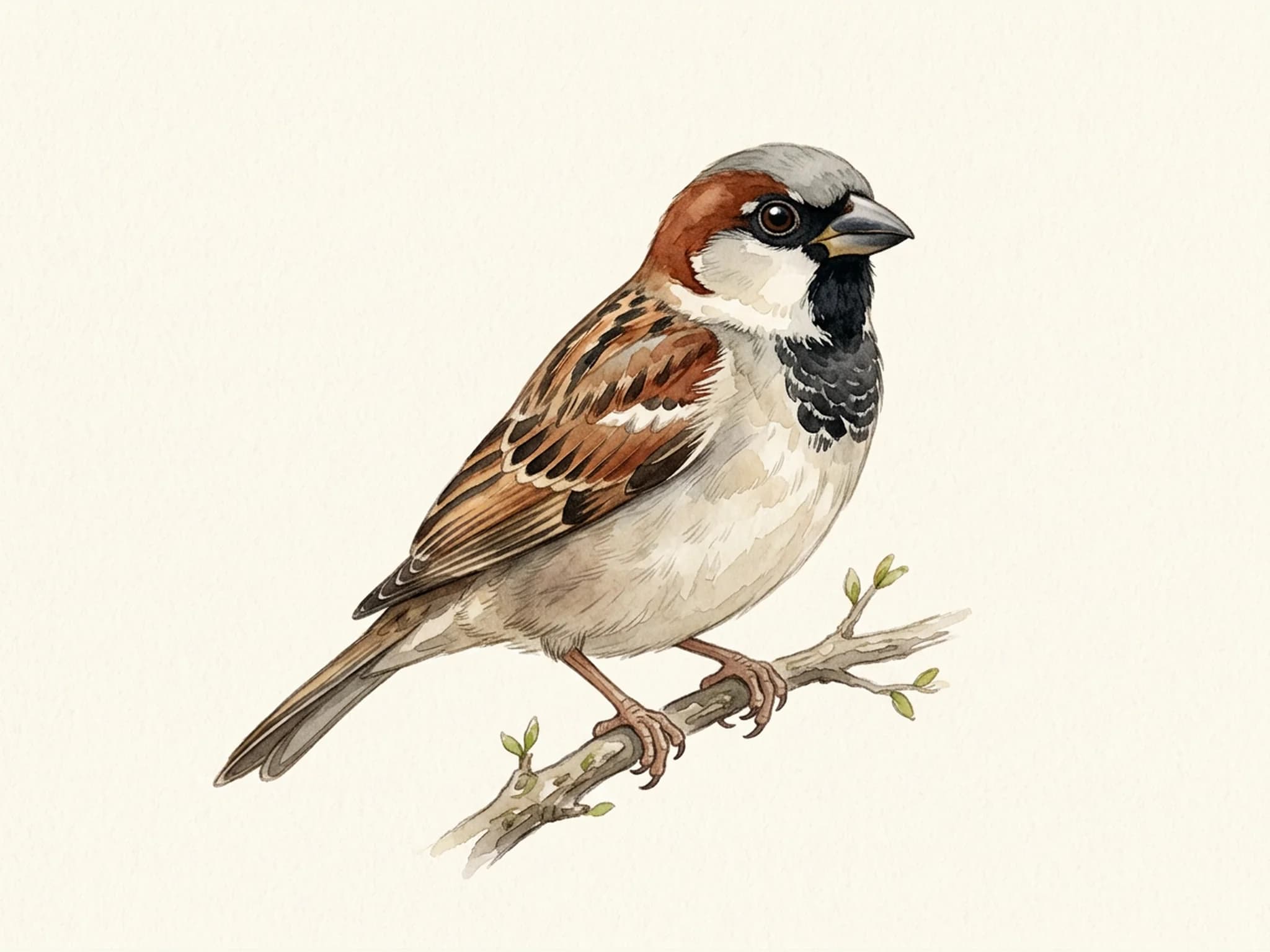
House sparrow
Passer domesticus
Also called: sparrow, English sparrow
An old companion of the vegetable garden: now in decline, it deserves our care.
The most familiar little bird of towns and cities lives where we live. It breeds in groups and feeds its chicks on insects, so it helps more than it seems.
Months when you can see it
How it helps in the garden
In spring it gives insects, aphids and caterpillars to its chicks; the rest of the year it eats the seeds of wild plants.
How to recognise it
- Size
- Small: 14–16 cm and 25–35 g.
- Colours
- The male has a grey crown, pale cheeks, black bib and streaked chestnut back; the female is plain brown with a pale eyebrow.
- Song
- A cheerful, repeated “chirp chirp”; in colonies it sounds like endless chatter.
What it eats through the year
Spring
Insects and aphids for the chicks; tender shoots.
Summer
Seeds, grain, insects and some fruit.
Autumn
Cereal and weed seeds, harvest leftovers.
Winter
Seeds, millet and sunflower at the feeder.
Breeding
- When
- From March to August.
- Broods
- 2–3.
- Eggs
- 3–5 whitish eggs with grey spots.
Which nest it uses
An untidy ball of grass and feathers under roof tiles, in holes in walls or in nest boxes; it breeds in colonies.
Its nest box · entrance
Ø 32–35 mm
- Inner base
- 130 × 130 mm
- Placement
- 3–5 m
- Orientation
- E–SE
How to attract it
Plants
Sunflower, millet and seed-bearing plants left uncut; hedges to shelter in.
Water
A drinking dish and a dust bath area (it loves dust-bathing).
Shelter
Thick hedges and holes under the eaves.
Nest box
Hole box with a 32–35 mm entrance, at 3–5 m, several together (it breeds in colonies).
What to avoid
Letting cats roam near its nests and feeders
In towns and cities they are the main cause of sparrow deaths.
Closing roof holes without checking they are empty
There may be a nest with chicks inside that would die trapped.
Giving them bread and pastries
They fill them up without nourishing them and the chicks grow up weak. Mixed seeds are better.
Setting out poisons and traps
They do not distinguish between species, so they also harm other birds and the animals that eat them.