
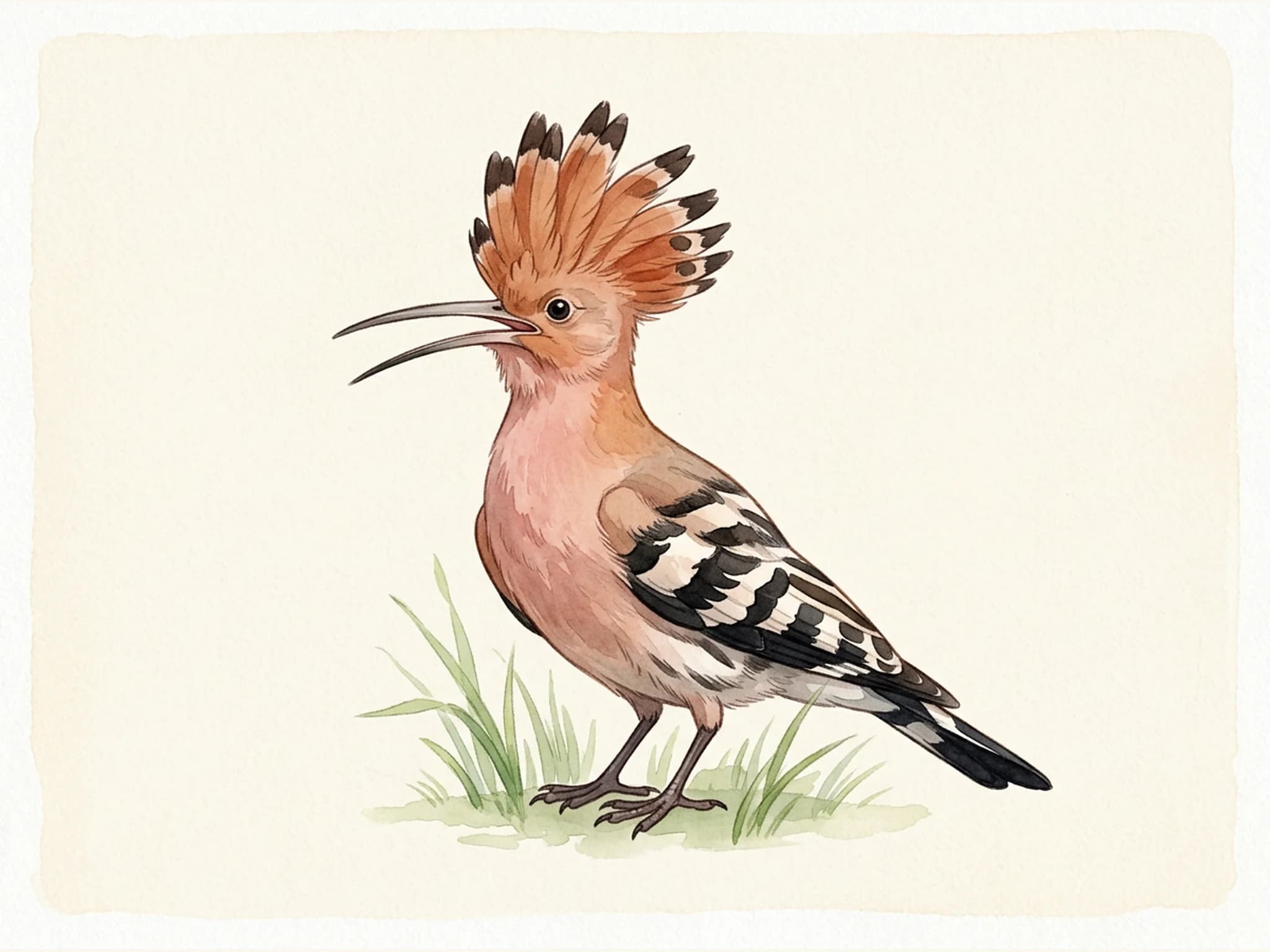
Eurasian hoopoe
Upupa epops
Also called: hoopoe, common hoopoe
It probes the ground with its long bill and finds grubs and mole crickets under the soil.
Unmistakable: a fan-shaped crest and pinkish, striped plumage. It visits meadows, olive groves and gardens with loose soil.
Months when you can see it
How it helps in the garden
It probes the soil and catches beetle grubs, mole crickets, white grubs and caterpillars, often hidden beside the roots.
How to recognise it
- Size
- Medium: 26–28 cm and 55–75 g.
- Colours
- Pinkish cinnamon body, wings and tail striped black and white, crest with black tips, long curved bill.
- Song
- A deep, monotonous “up-up-up” that gives the species its name.
What it eats through the year
Spring
Mole crickets, beetle grubs and ground caterpillars.
Summer
Grasshoppers, ants and larvae.
Autumn
Ground insects; it leaves for the south.
Winter
In the south and on the coast some spend the winter.
Breeding
- When
- From April to July.
- Broods
- 1–2.
- Eggs
- 5–8 greyish or bluish eggs.
Which nest it uses
Large holes: tree hollows, stone walls, barns or large boxes with a round entrance. The nest smells strongly; that is normal.
Its nest box · entrance
Ø 60–70 mm
- Inner base
- 200 × 200 mm
- Placement
- 2–4 m (or low down, camouflaged)
- Orientation
- E–SE
How to attract it
Plants
Untreated meadows and loose soils, with old trees nearby; olive trees and fruit trees with holes.
Water
A large drinking dish next to a short meadow.
Shelter
Stone walls with gaps and piles of stones.
Nest box
Large hole box (60–70 mm), at 2–4 m, facing E–SE.


What to avoid
Spraying insecticides on the soil of the garden or meadow
The hoopoe looks for grubs and mole crickets by sticking its bill in the earth, and would be left without food or eat poisoned prey.
Letting cats roam near low nests
It often breeds in holes close to the ground, within reach of a paw.
Closing holes in stone walls in spring
They are its breeding sites and you could trap a brood.
Going close to look at the nest
The female incubates alone and, if she feels threatened, may abandon the eggs.