
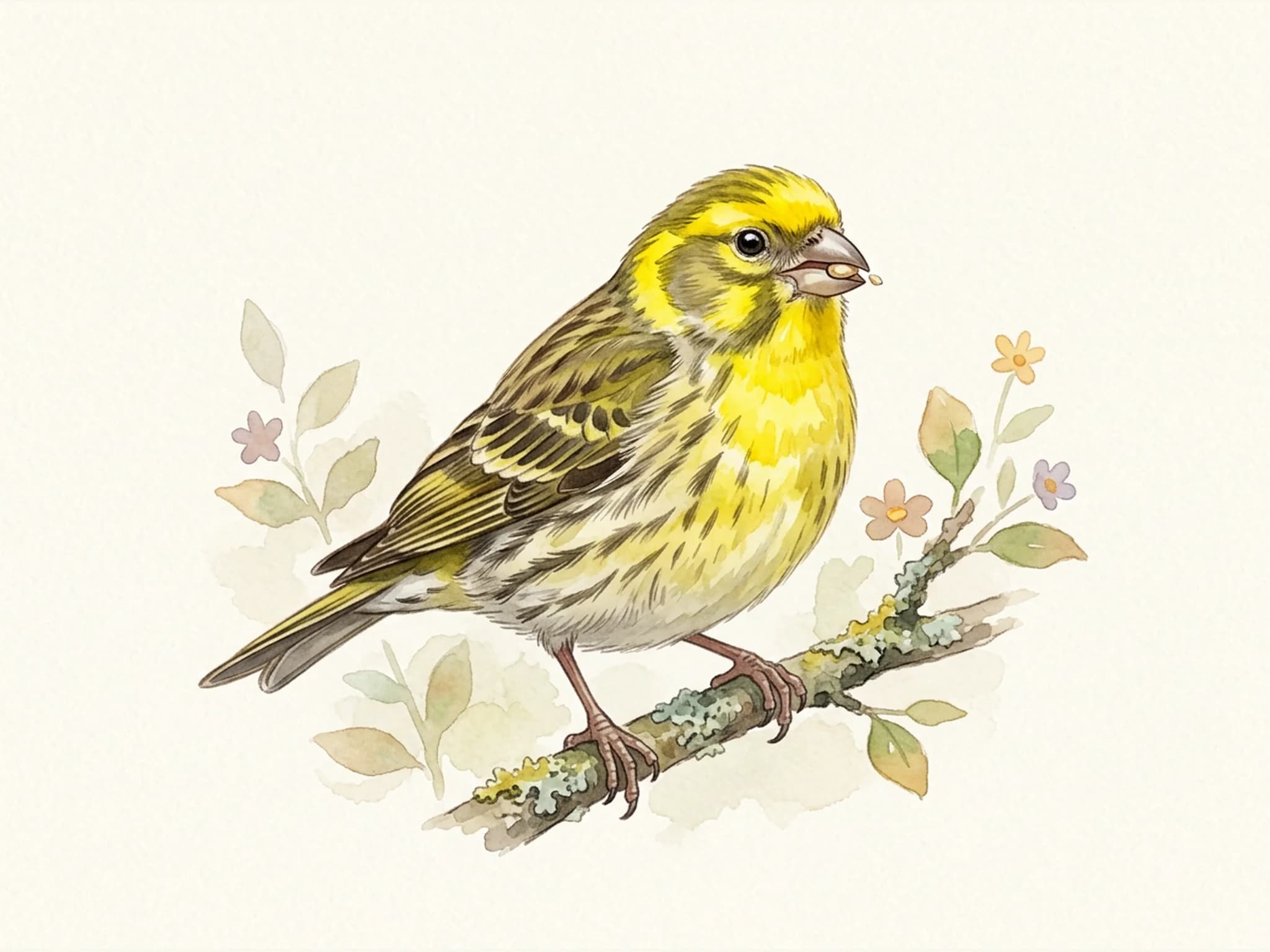
European serin
Serinus serinus
Also called: serin, wild canary
The garden’s “little canary”: it shares seeds and in return fills the fruit trees with music.
The smallest finch in Europe, yellow and streaked, which sings a string of very fast notes from the top of the trees.
Months when you can see it
How it helps in the garden
It eats seeds of wild plants, shoots and the odd aphid; it spreads seeds and keeps the growth of wild plants in check.
How to recognise it
- Size
- Very small: 11–12 cm and 11–13 g.
- Colours
- Lemon-yellow forehead and breast, olive-green streaked back and flanks; short, thick bill.
- Song
- A very fast metallic trill, like a stream of beads; it also sings in flight.
What it eats through the year
Spring
Shoots, tender seeds and small insects.
Summer
Seeds of wild plants and flowers.
Autumn
Seeds of thistles, daisy-family plants and cereals.
Winter
Small seeds and canary seed; it comes to feeders with the frosts.
Breeding
- When
- From April to August.
- Broods
- 2 (sometimes 3).
- Eggs
- 3–5 bluish eggs with little spots.
Which nest it uses
A tiny cup on the branches of pines, cypresses or fruit trees; it does not use nest boxes.
How to attract it
Plants
Conifers and small fruit trees to nest in; seed-bearing plants, thistles and daisies.
Water
A low-sided drinking dish; they come in groups to drink.
Shelter
Trees with a dense crown and hedges.
Nest box
It does not use a nest box: offer it conifers or fruit trees.
Plants from the catalogue it likes
 ScabiousA perennial with pincushion-like flowers on long, slender stems, a magnet for butterflies.
 CardoonThe same species as the globe artichoke, it is grown for its blanched leaf stalks, a Christmas dish in the…
 Shasta daisyA perennial with large white daisies with yellow centres all summer long, very easy to grow.
What to avoid
Cutting hedges and treetops in spring
It builds its nest among the branches and you would lose it with the eggs inside.
Using herbicides or clearing everything
It is left without the small-seeded plants that are its main food.
Letting cats roam and leaving glass unmarked
Cats catch it when it comes down to feed on the ground, and it hits glass because it sees the sky reflected.
Leaving feeders dirty or with damp seed
Wet seed grows mould and leftovers spread disease among birds.