
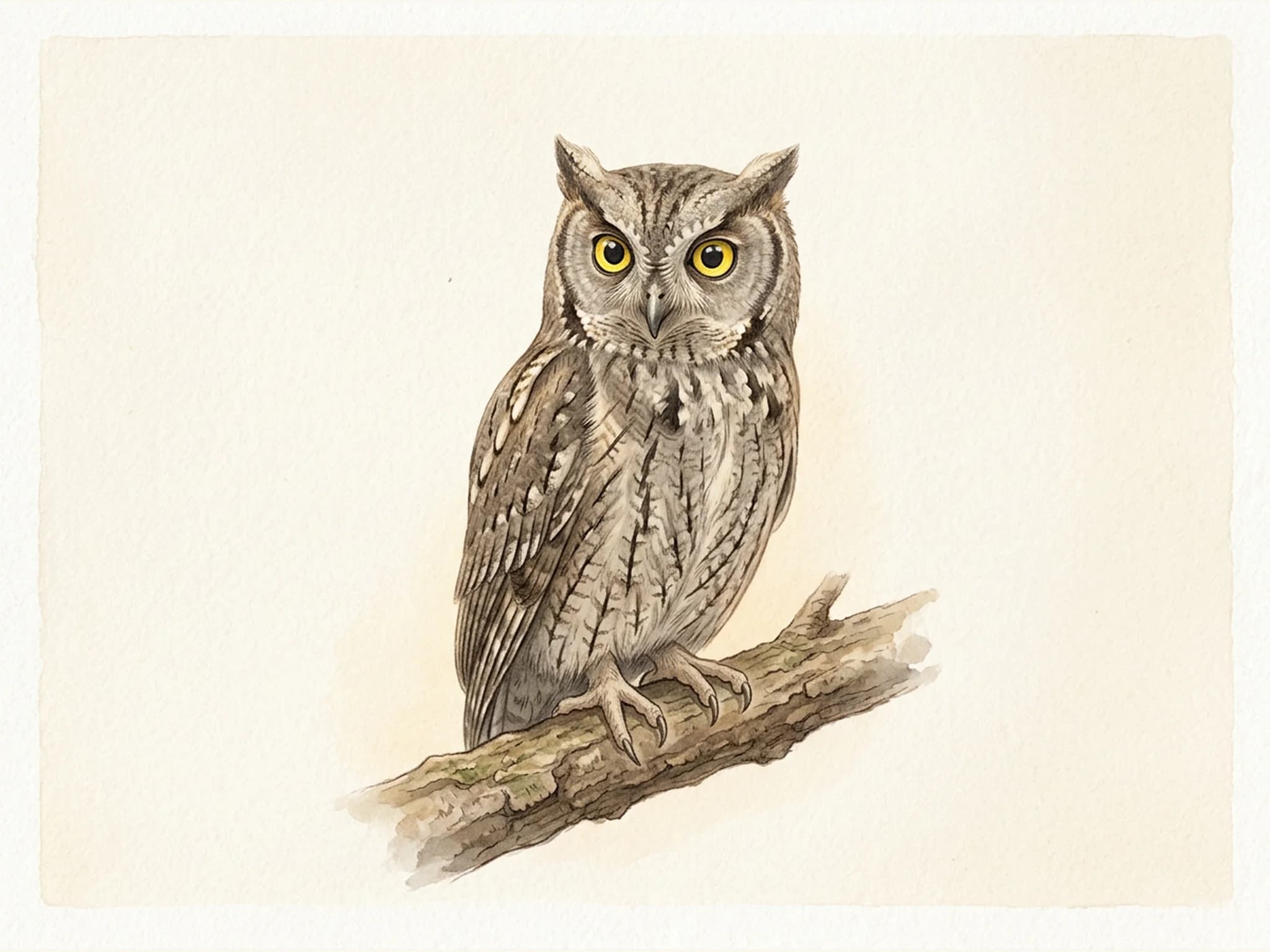
Eurasian scops owl
Otus scops
Also called: scops owl, European scops owl
A night hunter of moths and grasshoppers: its “piu” marks summer nights.
A tiny owl, camouflaged like a piece of bark. It arrives in spring in old trees, olive groves and gardens with trees.
Months when you can see it
How it helps in the garden
It eats moths, grasshoppers, crickets and large beetles, which it hunts at night; it complements the daytime birds.
How to recognise it
- Size
- Small: 19–20 cm and 70–100 g.
- Colours
- Grey-brown plumage streaked like bark, small tufts like ears, yellow eyes.
- Song
- A monotonous, fluting “piu”, repeated every few seconds for hours.
What it eats through the year
Spring
Moths and large nocturnal insects.
Summer
Grasshoppers, crickets, moths and beetles.
Autumn
Insects before leaving for Africa.
Winter
It is not in Spain: it migrates south of the Sahara (some winter in the south of the peninsula).
Breeding
- When
- From May to August.
- Broods
- 1.
- Eggs
- 3–5 white eggs.
Which nest it uses
Tree hollows, old nests of other birds or large boxes; it builds no nest.
Its nest box · entrance
Ø 75–80 mm
- Inner base
- 200 × 200 mm
- Placement
- 3–5 m, in a tree
- Orientation
- E–SE
How to attract it
Plants
Mature trees with holes (olives, holm oaks, walnuts) and dim light at night.
Water
A drinking dish hidden among trees.
Shelter
Old trees and branches with ivy to hide in by day.
Nest box
Large hole box of about 75–80 mm, at 3–5 m in a tree.
Plants from the catalogue it likes


What to avoid
Pruning or felling old trees with holes
They are where it breeds, and fewer remain every year.
Putting bright lights near the nesting tree
The scops owl hunts at night, and light gets in the way of hunting and makes it leave the area.
Using insecticides or rodenticides
It eats mostly large insects and the odd mouse, so it is left without food or is poisoned by its prey.
Letting dogs and cats roam the trees at night
The chicks come down to low branches before they can fly well and are easy prey.