
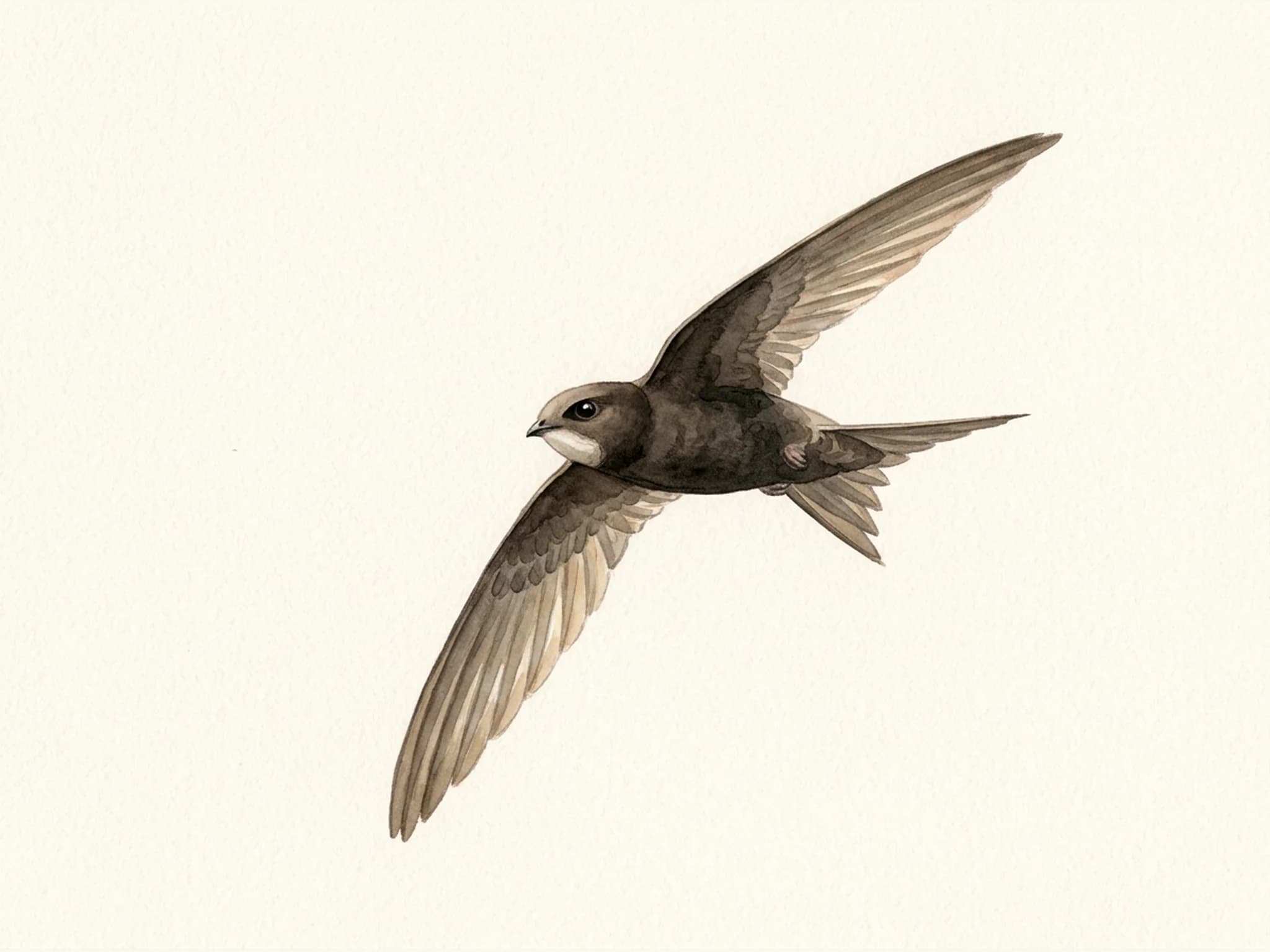
Common swift
Apus apus
Also called: swift, Eurasian swift
It spends almost its whole life flying and clears the sky of mosquitoes and winged aphids.
A sickle silhouette and shrill screams over the rooftops in summer. It only lands at a nest to breed; it returns to the same hole every year.
Months when you can see it
How it helps in the garden
It eats tiny flying insects at great height (mosquitoes, winged aphids); a family brings thousands of prey items a day.
How to recognise it
- Size
- Small: 16–17 cm, 40 cm wingspan and 36–45 g.
- Colours
- Dark brown, almost black plumage, a small pale throat; long sickle-shaped wings.
- Song
- A long, shrill scream, “sriiiii”, in noisy flocks at dusk.
What it eats through the year
Spring
Aerial plankton: insects and small spiders carried by the wind.
Summer
Mosquitoes, winged aphids and small winged ants.
Autumn
It leaves in August.
Winter
It is not in Spain: it winters in tropical Africa.
Breeding
- When
- From May to August.
- Broods
- 1.
- Eggs
- 2–3 white eggs.
Which nest it uses
Under roof tiles, in holes in walls and eaves; it accepts special boxes with an entrance underneath. The nest is made of feathers and straw stuck together with saliva.
Its nest box · entrance
65 × 30 mm slot
- Inner base
- 400 × 180 mm
- Placement
- ≥ 5 m, under an eave
- Orientation
- N–NE–E
How to attract it
Plants
A garden without insecticides and a sky with insects.
Water
It bathes and drinks on the wing: it does not need a drinking dish.
Shelter
Respect the gaps under tiles and eaves.
Nest box
Swift box under the eave, at 5+ m, with a clear flight path in front. Sound lures help.
What to avoid
Closing roof and eave holes between April and August
That is when they breed inside, and chicks and adults would be walled in.
Doing building work with scaffolding in the middle of breeding
It blocks the nest entrances, and swifts need to arrive flying in a straight line; if they cannot, they abandon the chicks.
Using pesticides or powerful lights at night
Pesticides wipe out the insects it catches in the air and strong lights disorient insects and birds.
Picking up a fallen adult swift and trying to look after it yourself
With its very short legs it cannot take off from the ground and needs specialist care. Call a wildlife rescue centre.