
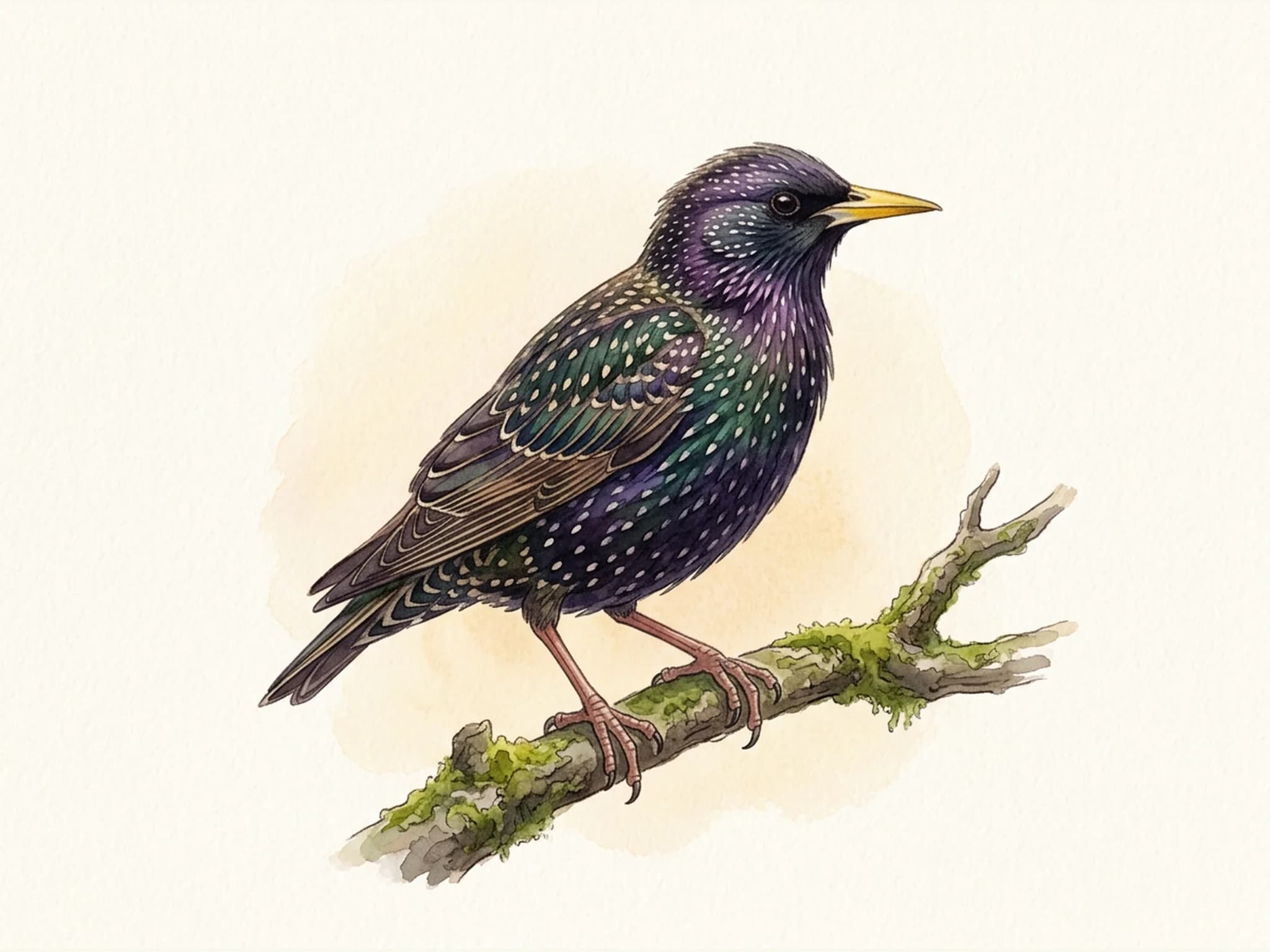
Common starling
Sturnus vulgaris
Also called: starling, European starling
It looks for grubs in the lawn and beds; if there are cherries, share them using a net.
A shiny mimic that moves in flocks. In winter the roosts can gather thousands; in spring it breeds in holes and boxes.
Months when you can see it
How it helps in the garden
It eats beetle grubs, crane-fly larvae, caterpillars and grasshoppers that hide in the lawn and beds.
How to recognise it
- Size
- Medium: 21–23 cm and 70–90 g.
- Colours
- Dark plumage with green and purple sheen and pale speckles in winter; yellow bill in spring.
- Song
- A mixture of whistles, clicks and imitations of other sounds, even a mobile phone.
What it eats through the year
Spring
Ground larvae, caterpillars and beetles.
Summer
Insects and ripe cherries or figs.
Autumn
Ripe fruit, berries and olives.
Winter
Fruit, food scraps and fat at the feeder.
Breeding
- When
- From April to June.
- Broods
- 1, sometimes 2.
- Eggs
- 4–6 pale blue eggs.
Which nest it uses
A mass of grass in a large hole: tree hollow, wall, roof or large hole nest box.
Its nest box · entrance
Ø 45 mm
- Inner base
- 160 × 160 mm
- Placement
- 3–5 m
- Orientation
- N–E
How to attract it
Plants
Meadows with soft soil where it can look for grubs, and fruit trees with a share-out: leave part of the fruit.
Water
A wide drinking dish where it can bathe in a group.
Shelter
Trees with holes and roof edges.
Nest box
Hole box with a 45 mm entrance, at 3–5 m, facing N–E.
Plants from the catalogue it likes

What to avoid
Protecting fruit with large-mesh nets
Birds put their heads or feet through, get tangled and die. Use fine, well-stretched netting and check it often.
Using chemical repellents or traps to drive it off
They poison or injure any bird that comes near. For fruit, fine-mesh netting is enough.
Feeding it bread or processed food
It fills them without nourishing them and salt and additives make them ill.
Blocking roof holes in spring
That is when they breed inside, and the chicks would be trapped.