
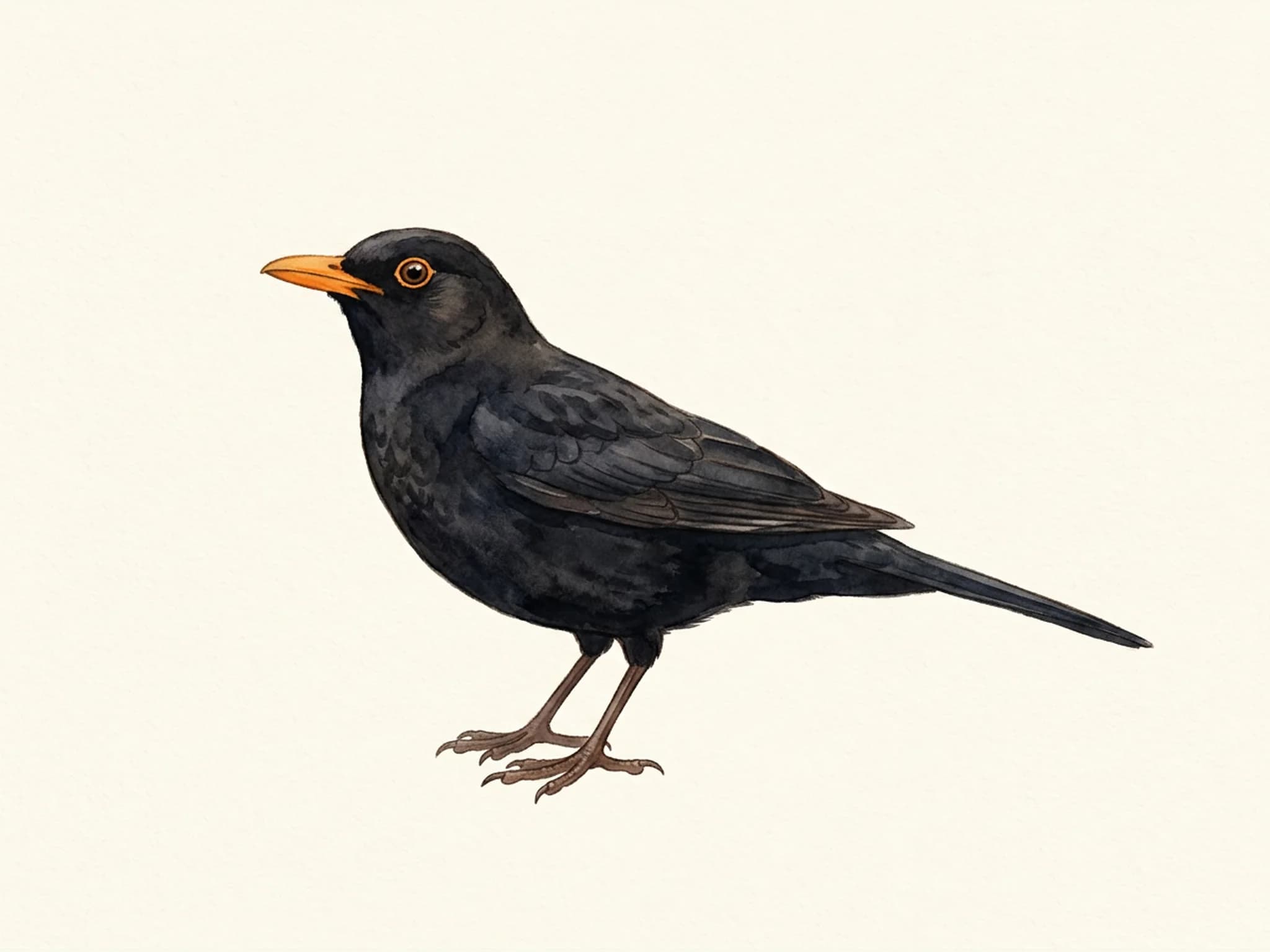
Common blackbird
Turdus merula
Also called: blackbird, Eurasian blackbird
It turns over the leaf litter looking for worms; in return, it sings to you at dusk.
A black bird with an orange bill that hops across the lawn and the beds. Its fluting song is one of the loveliest in gardens.
Months when you can see it
How it helps in the garden
It eats earthworms, grubs, beetles, small snails and ground caterpillars; it also spreads the seeds of shrubs.
How to recognise it
- Size
- Medium: 24–27 cm and 90–120 g.
- Colours
- Male glossy black with an orange bill and eye ring; female brown with a speckled breast.
- Song
- A slow, rich, fluting melody at dawn and dusk; its alarm call is a shrill “tic-tic-tic”.
What it eats through the year
Spring
Earthworms, grubs and ground caterpillars.
Summer
Insects, small snails and fallen fruit.
Autumn
Berries (ivy, strawberry tree, elder), fallen fruit and apples.
Winter
Split apples, raisins, earthworms and berries.
Breeding
- When
- From March to July.
- Broods
- 2–3.
- Eggs
- 3–5 blue-green eggs with brown speckles.
Which nest it uses
A sturdy cup of grass and mud in hedges, ivy, low trees or ledges. It accepts semi-open platforms.
Its nest box · entrance
Open front
- Inner base
- 200 × 200 mm
- Placement
- 1.5–3 m, in a hedge or under an eave
- Orientation
- N–NE
How to attract it
Plants
Hedges with berries, ivy on a wall, fruit trees and soil with leaf litter.
Water
A wide drinking dish where it can bathe.
Shelter
A dense hedge and sheltered ledges.
Nest box
Large platform or semi-open box, under an eave or in a dense hedge at 1.5–3 m.
Plants from the catalogue it likes

What to avoid
Letting cats roam in spring
Young blackbirds leave the nest before they can fly well and spend a few days on the ground, where they are easy prey.
Putting out snail bait
The blackbird eats snails and slugs, and if they are poisoned it is poisoned too.
Giving it bread or salty food
Bread fills it without feeding it and salt harms it. Ripe fruit, soaked raisins or mealworms are better.
Pruning the hedge in spring
It often has its nest inside and it would be destroyed or exposed to predators.