
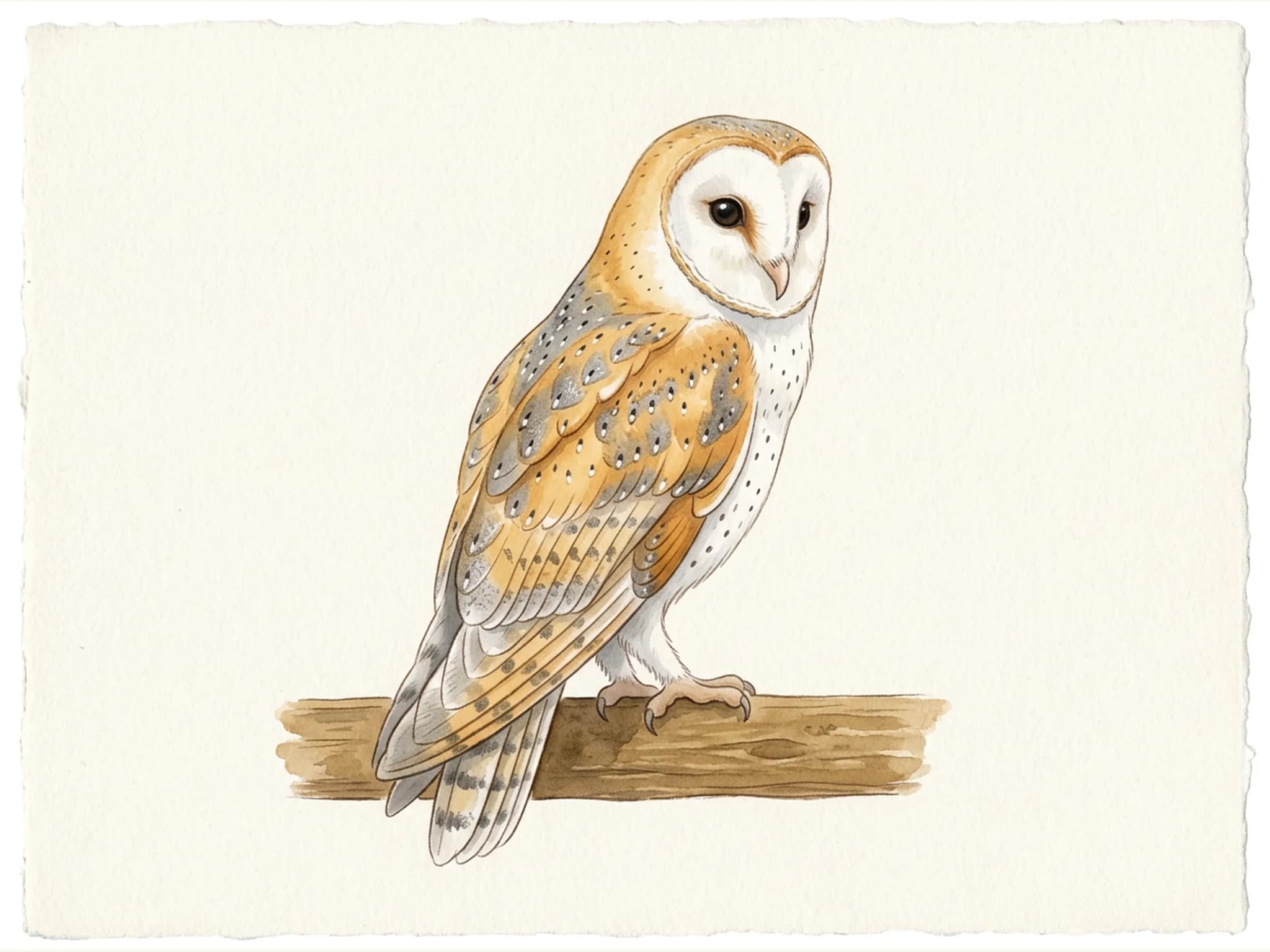
Barn owl
Tyto alba
Also called: white owl, church owl
A pair with chicks can eat more than 1,000 rodents a season.
Silent and white as a ghost, it hunts in low flight over meadows and gardens. It needs barns, bell towers or large boxes.
Months when you can see it
How it helps in the garden
It eats mostly voles and mice; a pair with chicks can remove many hundreds or over a thousand rodents, without poisons.
How to recognise it
- Size
- Large: 33–39 cm and 300–400 g, 90 cm wingspan.
- Colours
- Heart-shaped white face, golden back with grey speckles, white or slightly pinkish belly; black eyes.
- Song
- It does not hoot: it gives a long, harsh hiss (“chiiiish”).
What it eats through the year
Spring
Voles, mice and shrews.
Summer
Rodents, some large insects and small birds.
Autumn
Rodents in stubble and crop edges.
Winter
Field and storehouse rodents.
Breeding
- When
- From March to September (depending on prey abundance).
- Broods
- 1, sometimes 2 if there are many rodents.
- Eggs
- 4–7 white eggs.
Which nest it uses
Bell towers, barns, abandoned farmhouses and large boxes with an entrance compartment; it builds no nest.
Its nest box · entrance
150 × 150 mm entrance
- Inner base
- 400 × 800 mm
- Placement
- ≥ 6 m, in a barn or on a pole
- Orientation
- N–E (no direct sun on the entrance)
How to attract it
Plants
Crop edges and meadows with tall uncut grass, hedges and field margins.
Water
It does not need a drinking dish; it does need open hunting areas.
Shelter
Barns, lofts and towers with open access.
Nest box
Large barn owl box with an inner screen, at 6 m or more, in a barn or on a pole, with the entrance out of direct sun.
What to avoid
Using rodenticides
They are its main cause of death, because it catches poisoned mice and is poisoned. Use traps and keep the storeroom clean.
Driving fast on roads at night
The barn owl hunts in low flight over the verges and many die hit by vehicles. Slow down.
Closing barns and lofts without leaving it an entrance
They are where it breeds, and without them it has nowhere to go.
Using bright lights or making noise next to the nest
It is very sensitive to disturbance and may abandon the brood.