
Raising crickets (Acheta domesticus) for your birds
The house cricket (Acheta domesticus) and, less often, the banded cricket (Gryllodes sigillatus) and the field cricket (Gryllus bimaculatus) are the common farmed species. They give a lot of protein, but need warmth, make noise (the males sing) and smell more than mealworms. They are a good option if you have already raised mealworms and want more variety.
- Difficulty: medium
- Acheta domesticus
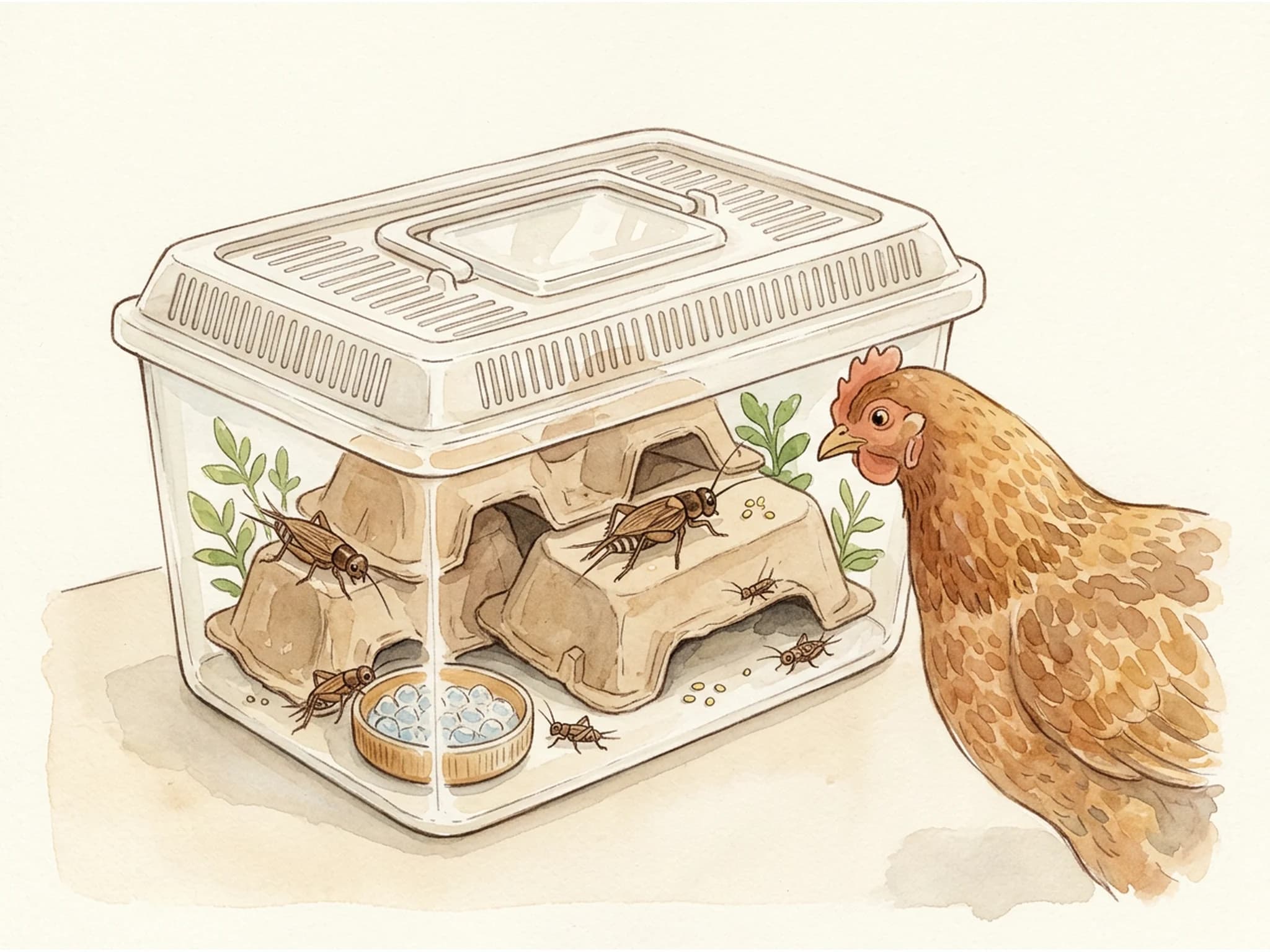
Which animals it suits and how much to give
- Chickens
- 3–5 g per hen per day (about 3–5 large crickets); never more than 10% of the ration.
- Ducks
- 3–5 g per duck per day.
- Quail
- 1–2 g per quail per day, with small crickets.
- Pond fish
- Small crickets, a few, 1–2 times a week.
- Rabbits and hedgehogs
- No.
Indicative doses: a supplement to a complete feed. See the table for all the animals.
Materials
- Plastic box of 60 × 40 × 30 cm with smooth walls and a ventilated mesh lid
- 4 egg cartons or cardboard tubes to hide in and climb
- A shallow drinker with sponge or water gel (crickets drown in free water)
- A shallow container with damp soil or coconut fibre for egg-laying
- Heat mat with thermostat and a thermometer-hygrometer
- Chick feed, oats and fresh vegetables (carrot, lettuce, apple)
- Paper tape or petroleum jelly on the inner rim if they climb
Set-up measurements
- Box
- 600 × 400 × 300 mm, smooth walls
- Climbing surface
- 4 egg cartons stood upright
- Water
- Drinker 80 mm in diameter with sponge
- Temperature
- 28–32 °C (below 22 °C they do not reproduce)
- Air humidity
- 40–60%
- Egg-laying
- 10 × 10 cm container with 3 cm of damp coconut fibre
- Density
- At most 1 adult cricket per 10 cm² of surface, to avoid cannibalism
Diagram drawn by a program with the same measurements as the table. The temperature and humidity figures are indicative.
Step by step
- 1
Prepare the box
Cut a large window in the lid and cover it with fine 1 mm mesh. Stick a smooth rim (wide tape or petroleum jelly) on the inside so they cannot escape.

- 2
Add the heat
Put the heat mat under a third of the box with a thermostat at 30 °C, so there is a warm zone and a cool zone.

- 3
Add hiding places
Stand egg cartons upright, filling half the volume: they give surface area and reduce cannibalism.

- 4
Put in water and food
Moisten a sponge in a flat drinker. Give feed, oats and a slice of vegetable every day; remove any leftovers after 24 h.

- 5
Introduce the crickets
Buy 50–100 juvenile crickets from a pet shop. Leave the box in a quiet, dark place.

- 6
Put in the egg-laying container
When the crickets are adult (at 6–8 weeks), put in the container with damp coconut fibre. The females lay in it; take it out every week and move it to a new box.

- 7
Harvest
Take out the crickets with the cardboard and shake it over a bucket. Give them to the birds live or freeze them for 24 h. Always leave a group of breeders.

Cycle and timings
| Stage | Duration | What happens |
|---|---|---|
| Egg | 10–14 days at 30 °C | Laid in damp soil; they are elongated and cream-coloured. |
| Nymph | 6–8 weeks (8–10 moults) | They look like miniature crickets without wings. |
| Adult | 2–3 months of life | With wings; the males sing. The females have a long ovipositor. |
Maintenance
- Remove dead crickets and leftover food daily.
- Change the substrate in the box every 2–3 weeks.
- Clean the drinker every 2 days to avoid bacteria.
- Vacuum or clean the droppings (frass) regularly: they serve as fertiliser.
If a cricket escapes, pick it up: farmed ones can carry diseases to wild crickets and compete with them.
Common problems
Smells, mites, mould, leaks and others: why they happen and how to fix them.
Strong smell
Why it happens: High humidity, food or corpses rotting.
What to do: Ventilate more, remove leftovers daily and cut back on vegetables.
Mites
Why it happens: Humidity and accumulated food.
What to do: Change the boxes and stop giving fruit and vegetables for 1 week.
Mould
Why it happens: Poor ventilation.
What to do: Increase ventilation and remove anything mouldy.
Cannibalism
Why it happens: Lack of food, of shelter or too many crickets.
What to do: More cartons, more protein (chick feed) and lower density.
Mass die-off
Why it happens: Viral infection (house cricket densovirus) or chilling.
What to do: There is no treatment: discard the colony, disinfect with diluted bleach and start with crickets from another source. Buy from reliable breeders.
Escapes
Why it happens: Lid not closed properly or rough walls.
What to do: Cover with mesh, smooth walls and a tape rim.
Yield
- A box like this with a healthy group of breeders gives, after a 2–3 month start-up, about 100–300 g of crickets a month (indicative).
- Each adult cricket weighs 0.3–0.5 g, so 100 g is 200–300 crickets.
Safety and hygiene
- Wash your hands with soap after touching the colony or the substrate.
- Cricket-farm dust is a known allergen: wear a mask when cleaning and keep the colony in a ventilated place.
More information on the site
Sources
Figures synthesised from these sources; where each author gives different values, they appear as a range or as “indicative”.
- Reviews on rearing the house cricket (Acheta domesticus) and Gryllodes sigillatus as animal feed, including the AdDNV virus
- FAO (2013): Edible insects. Future prospects for food and feed security