
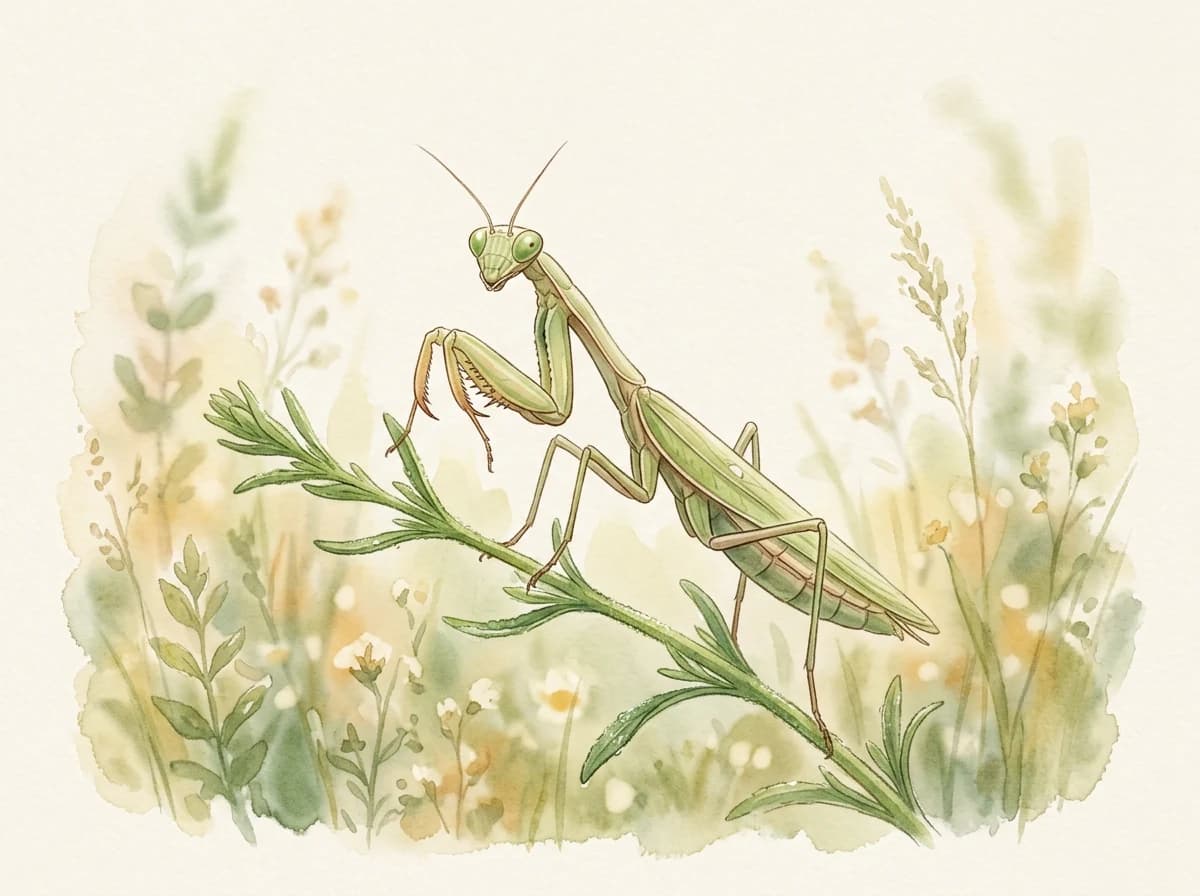
Praying mantis
Mantis religiosa
Also called: mantis, European mantis, Mantis religiosa, preying mantis
An ambush hunter, green or brown. It eats whatever it can catch: garden pests as well as the odd small pollinator. It is impressive to watch them hunt, but they are peaceful with people and useful in the garden.

How to recognise it at every stage
Garden allyGarden ally: it ambushes flies, grasshoppers and moths.
Life cycle: Incomplete metamorphosis: the eggs spend the winter inside an ootheca, in spring dozens of nymphs emerge and moult six or seven times during the summer, and the adults appear at the end of summer. One generation a year.
Tap a stage to see it full size. The photos are AI reference images checked against real photographs; stages without a reliable photo are shown as text only.
Life-stage calendar
| Jan | Feb | Mar | Apr | May | Jun | Jul | Aug | Sep | Oct | Nov | Dec | |
|---|---|---|---|---|---|---|---|---|---|---|---|---|
| Ootheca (egg case) | ||||||||||||
| Nymph | ||||||||||||
| Adult |
Approximate months for mainland Spain; in cold areas they start later and in warm areas they last longer. Garden creatures this month
- 1Protect it
Ootheca (egg case)
· 2-4 cmAn elongated lump of hardened foam, beige or brown, with a seam down the middle, stuck to a branch or stone.
- Where to find it
- On branches, dry stems, stones, fences and sunny walls.
- When: Sep–May
- What to do
- Do not remove it or burn it with the pruning waste: there are up to 200 mantises inside. If you cut that branch, leave it in a hedge.
- Often confused with
- Ootheca versus a moth cocoon or a large scale insect. The ootheca is hard, made of dry foam, with a central seam; it is not cottony or soft.
- 2Protect it
Nymph
· 5 mm-5 cmA miniature mantis, wingless, green or brown, that raises its abdomen.
- Where to find it
- In tall grasses, flowers and shrubs.
- When: May–Jul
- What to do
- Leave it: it already hunts aphids and gnats.
- 3Protect it
Adult
· 5-8 cmGreen or brown, with its front legs folded as if in prayer and a black spot with a white centre on the "armpit".
- Where to find it
- Motionless on shrubs, flowers and tall grasses.
- When: Aug–Nov
- What to do
- Protect it: it is a useful species. Do not bring it indoors; leave a corner of tall grass.
- Often confused with
- Stick insect or empusa. The stick insect has no hunting legs; the empusa (Empusa pennata) has a "crest" on its head and feathery antennae. It is an ally too.
Often confused with
- Ootheca versus a moth cocoon or a large scale insect. The ootheca is hard, made of dry foam, with a central seam; it is not cottony or soft.
- Stick insect or empusa. The stick insect has no hunting legs; the empusa (Empusa pennata) has a "crest" on its head and feathery antennae. It is an ally too.
Sources
What it eats
- Any insect of its size: flies, butterflies, grasshoppers, large caterpillars.
- Occasionally pollinators: its downside is that, given the chance, it also hunts bees.
How it helps in the garden
How to attract this ally to your garden
- Areas with tall grass and low shrubs such as thyme, sage or rosemary: there they hide and wait for the insects that come to the flowers.
- Dense hedges where they can hunt from ambush: they give daytime cover to useful predators.
- Respect the oothecae, those brown, hardened-foam-looking masses on branches and walls: they hold the eggs, which are laid in autumn and hatch in spring.
Plants in the catalogue that attract it
 ThymePerennial thyme for poor, dry soil, ideal for sunny borders.
 Pineapple sageA perennial Salvia whose leaves have a fruity pineapple scent.
 RosemaryA Mediterranean shrub that is very tough once established.
 PrimroseOne of the first flowers of the year, with rosettes of crinkled leaves and flowers in many colours, for cool…
What to avoid so you do not harm it by accident
- Removing the oothecae thinking they are a pest's nests: they are its eggs.
- Any broad-spectrum insecticide while plants are in flower: it kills pollinators and pest predators alike.
How to recognise it
5-8 cm, green or brown, enormous front legs shaped like a folded claw (the "praying position"), triangular head that turns 180º.
Risk to people: None for people: it does not usually bite and, if it does, it is harmless.
Many allies are protected by Spanish law: do not capture or keep in captivity toads, hedgehogs, bats or native reptiles. Attract them, watch them and thank them from a distance. Rules in other countries differ: check your local regulations.

Allies do better if the garden is varied. Learn to identify each visitor and to prevent problems with good habits.