
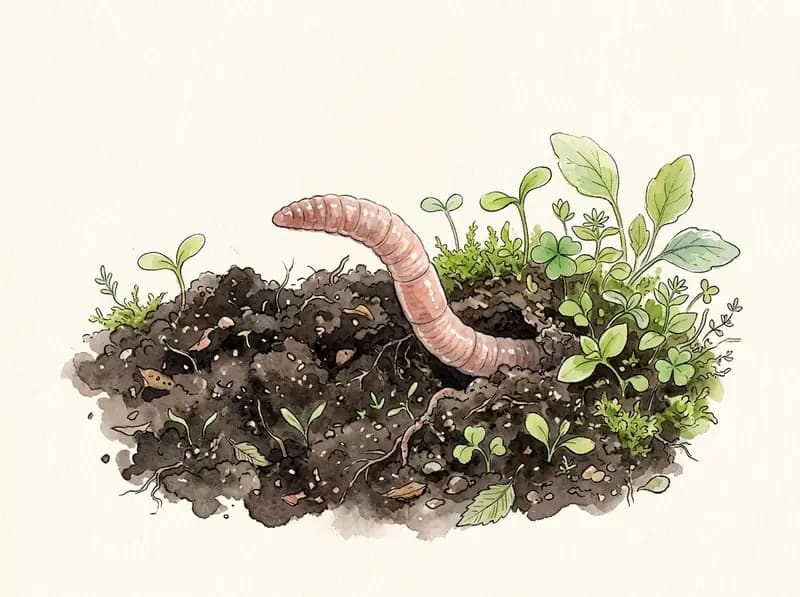
Earthworm
Lumbricus terrestris, Eisenia fetida
Also called: common earthworm, nightcrawler, red wiggler, lob worm
They aerate and feed the soil non-stop. If you see several earthworms when you lift a spadeful of soil, your soil is alive. If you see none, it is worth checking how you are looking after it.

How to recognise it at every stage
Garden allySoil ally: it aerates the earth and turns it into humus.
Life cycle: No metamorphosis: two hermaphrodite earthworms mate and each forms cocoons with eggs; one or several little worms hatch from each cocoon. They are adults in a few months, when the ring (clitellum) appears.
Tap a stage to see it full size. The photos are AI reference images checked against real photographs; stages without a reliable photo are shown as text only.
Life-stage calendar
| Jan | Feb | Mar | Apr | May | Jun | Jul | Aug | Sep | Oct | Nov | Dec | |
|---|---|---|---|---|---|---|---|---|---|---|---|---|
| Cocoon | ||||||||||||
| Little worm | ||||||||||||
| Adult | ||||||||||||
| Worm casts (little heaps of earth) |
Approximate months for mainland Spain; in cold areas they start later and in warm areas they last longer. Garden creatures this month
- 1Protect it
Cocoon
· 3-6 mmA lemon-shaped little ball, yellow or greenish, that turns brown.
- Where to find it
- In damp soil, in compost and in the worm bin.
- When: Feb–Jun, Sep–Nov
- What to do
- If you see them when sieving compost, put them back on the heap.
- 2Protect it
Little worm
· 1-3 cmA small earthworm, pale or whitish, with no ring.
- Where to find it
- In the soil and the compost.
- When: Mar–Jun, Oct–Dec
- What to do
- Keep the soil covered and moist.
- 3Protect it
Adult
· 5-25 cmPink or red, with a thicker, paler ring (clitellum) in the first third of the body.
- Where to find it
- In soil burrows; it comes to the surface at night and when it rains.
- When: all year
- What to do
- Mulch, organic matter and little tillage. No strong chemical fertilisers.
- Often confused with
- Land planarian (invasive flatworm). Flattened like a ribbon, with a hammer-shaped or pointed head and slimy; it eats earthworms. Report it if you see it.
Nests, egg clutches and shelters
- Protect it
Worm casts (little heaps of earth)
Little heaps of fine, coiled soil on the surface: they are earthworm droppings.
- Where to find it
- On the lawn, in beds and on paths after rain.
- When: Oct–Apr
- What to do
- A good sign! It is first-class humus: spread those little heaps with the rake.
Often confused with
- Land planarian (invasive flatworm). Flattened like a ribbon, with a hammer-shaped or pointed head and slimy; it eats earthworms. Report it if you see it.
What it eats
- Decomposing organic matter
- Plant remains, fallen leaves, compost
- Soil microorganisms and fungi
How to attract this ally to your garden
- Cover the soil with a mulch of straw, leaves or cardboard: earthworms avoid direct sun and withdraw if the soil is left bare.
- Add well-matured compost or manure every year, best in autumn and at the end of winter.
- Avoid turning the soil with a rotavator: it chops the earthworms up.
- Keep the moisture like a wrung-out sponge: if waterlogged they drown; if dry, they leave that area.
What to avoid so you do not harm it by accident
- Digging deeply with a motorised tiller: it destroys the burrows and kills many earthworms.
- Concentrated chemical fertilisers: they are very sensitive to pH and salt.
- Compacted, dry or waterlogged soil: earthworms cannot breathe or move and leave that area.
How to recognise it
5-20 cm, reddish or pinkish, segmented body. They come up to the surface after heavy rain. Their burrows look like vertical holes of 3-5 mm.
Risk to people: None.
Many allies are protected by Spanish law: do not capture or keep in captivity toads, hedgehogs, bats or native reptiles. Attract them, watch them and thank them from a distance. Rules in other countries differ: check your local regulations.

Allies do better if the garden is varied. Learn to identify each visitor and to prevent problems with good habits.